
By SLCgreen Intern Frances Benfell
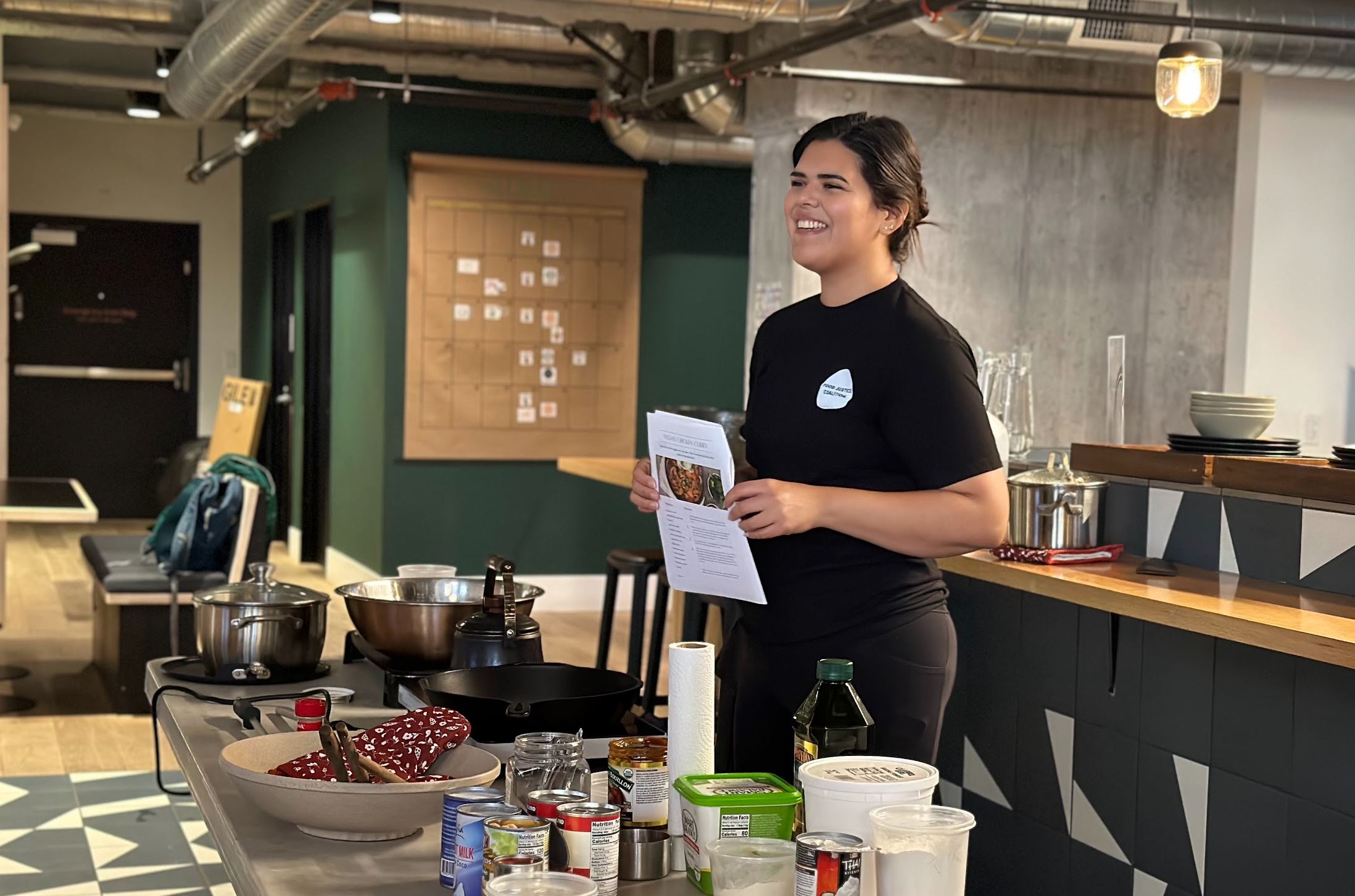
According to Jeanette Padilla Vega, the founder and CEO of the Food Justice Coalition (FJC), humanity’s greatest unifier is food. As she put it, her organization is “trying to change the world one rice bowl at a time.” As I observed her community cooking class and the aromas of her vegan chicken curry filled the air, I believed in her food’s world-changing power.
The FJC was one of 13 community organizations awarded a Salt Lake City Food Equity Microgrant this year.
How the Work Started
Jeanette comes to this work with a great deal of understanding and compassion. As a first generation Mexican-American, her family faced homelessness and food insecurity upon arriving to the United States. As we talked about her background, Jeanette told me of an experience she had in the third grade.
“There was a canned food drive to help underprivileged families [at my school] and I remember thinking like, ‘oh this is so cool! This is so great!’ not realizing that I was in an underprivileged family and these boxes were going to my family.”
When she moved to Utah and saw the need for community food assistance, she took action. During the holidays in 2020, armed with her private chef expertise and passion for food security, she posted on Instagram asking for donations for her to cook a Christmas dinner for those experiencing homelessness. People responded overwhelmingly. Donations kept pouring in. The drive raised $4,200—Jeanette was aiming for $400. Along with friends and volunteers, Jeanette put on a five-course dinner for 200 people experiencing homelessness.
Afterward, Jeanette recounts, “We had…money leftover [so] we just kept making meals and distributing them and then people kept donating more money to the Venmo, and then we kept making more meals and eventually, a year later, it turned into a full-on non-profit.”
What does the FJC do?
Approximately 350,000 Utahns face food insecurity and, at the same time, it’s estimated 600,000 tons of food is wasted every year in the state. The FJC fights against hunger through a coalition of non-profits, restaurants, students, volunteers, and other community stakeholders. Their mission is to create “food security through free, nutrient-dense meals, food sovereignty education, and advocacy.” They do this work through three programs: advocacy, direct relief, and community education and enrichment.
Advocacy First
First, the FJC acknowledges and fights disparities in our built food systems by engaging with community leaders and stakeholders through their advocacy program. Jeanette outlined the crux of the issue: “We think that we are being fair when we say, ‘why should I help when you’re not pulling yourself up from your bootstraps?’ …[but] we all live as part of a collective whether we like it or not. If you ignore people experiencing homelessness, they’re tapping into emergency services in this city that your tax dollars fund…Would you rather keep ignoring people that are suffering, that don’t have basic needs met, and [have] your tax dollars [go] to basically put a band aid on that situation? Or…help get people to a better place where their basic needs are met so then your tax dollars are being used to fund …more benefits for the community that you live in, more benefits for you and your family and your children and your friends? I think I would like the latter.”
Direct Relief
For two years, the FJC has provided direct relief by delivering fresh, plant-based meals to the food insecure and those experiencing homelessness. While the FJC is a plant-based organization, their core value of food sovereignty means that they aren’t telling anyone what or how much to eat. This program started the summer of 2020 when Jeanette was in the streets fighting for social justice. She remembers, “People living on the street were asking us for food. It happened so often that I thought, ‘we have to do something about this.’ We can’t just keep saying ‘no I don’t have any.’”
The organization works with local farmers and restaurants to “take surplus and donated food and turn it into beautiful meals.” The FJC also offers a free lunch program, aimed at housed individuals, that offers “fresh, healthy, prepared meals with options for weekly pick up of prepped meals.” The organization has served over 50,000 meals to date.
Education & Enrichment
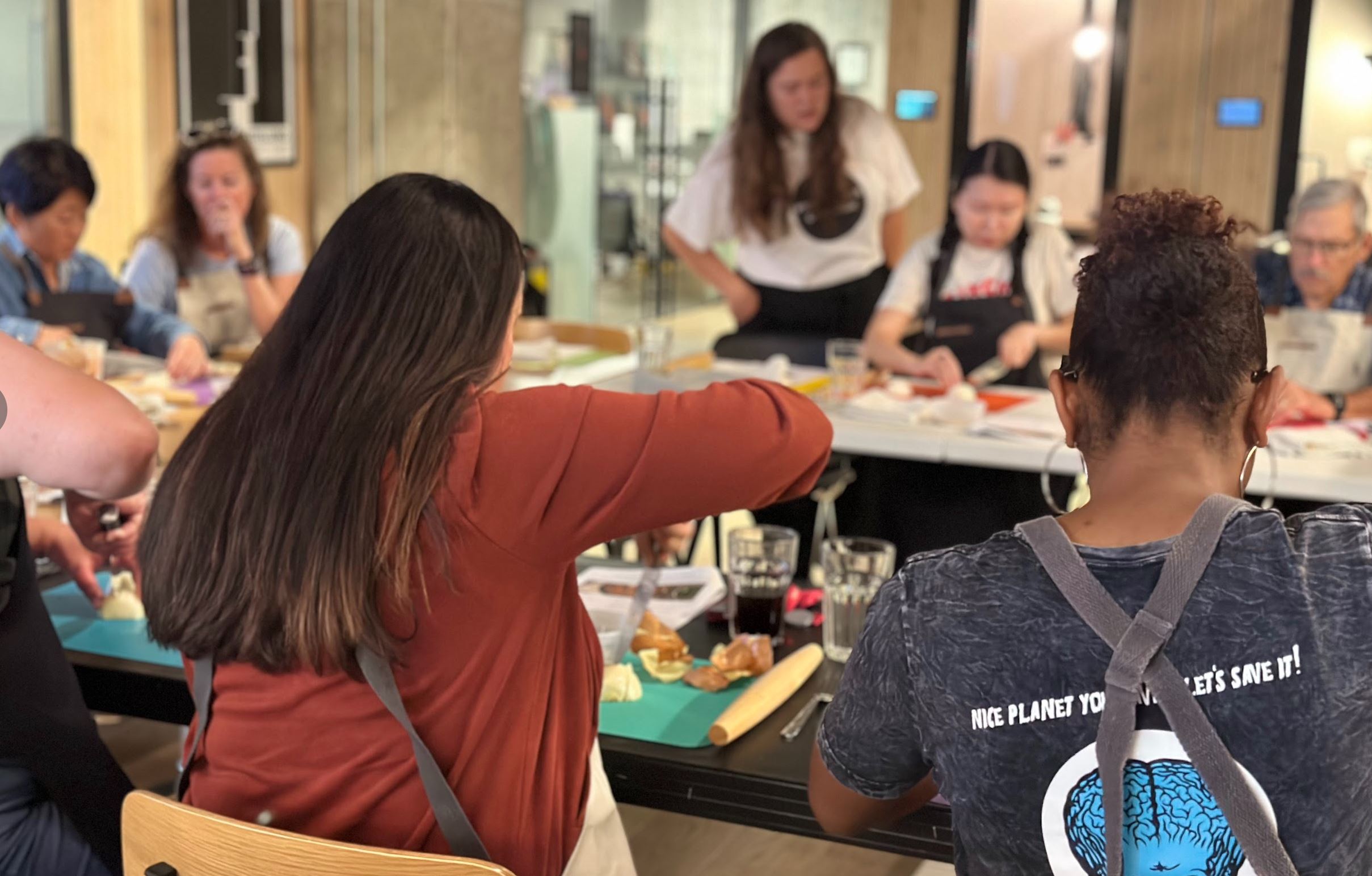
I got an inside look at the community enrichment program. The purpose of this initiative is to educate and empower the public on nutrition, cooking skills, and food waste reduction. I observed a recent Plant Based Cooking Class that provides students with hands-on cooking experience along with detailed education on nutrient profiles, food sovereignty, and general food information. While participants must pay for a spot, Salt Lake City’s Food Equity Microgrant funding has allowed the FJC to offer the class for free to individuals with financial barriers.
Participants in the class learned how to properly dice garlic, sharpen and hold a chef’s knife, and even how to use a recipe’s scraps to create a homemade veggie stock. Jeanette described the nutrition, prices, best brands, health effects, and accessibility of each ingredient. I overheard one participant say to another, “isn’t it funny that we don’t know these basic skills? Like, why don’t we learn this in school?”
Food insecurity isn’t only caused by the inability to afford food; the challenges of feeding yourself or your family may also be due to a lack of time or skills to cook.
What the Future Holds
The long-term goal of the FJC is to become “a community hub where people are welcome to come in any day of the week” including a commercial kitchen that will house all of their programs.
Overall, “the collective goal is to ensure that people have their basic needs met and then some.” The FJC wants everyone to have dignified, culturally-relevant, nutritious, and delicious food. A core value of the organization is the decolonization of food— “when you detach people from their food culture you detach them from who they are. That is a horrible thing to do to someone…everyone deserves access to that, regardless of who you are.”
Jeanette is often “told that the food is too nice and that [they] are doing too much, that it doesn’t have to be so over-the-top.” But the FJC fights against this idea, arguing that the notion of settling for less, for breadcrumbs, “is conditioning from the system.”
Food as a Unifier
Food is foundational and a common denominator between all of us. As Jeanette put it, “we think we are so different from each other, from country to country, from zip code to zip code, but we’re really not. If you look at a potsticker—it’s like a gyoza, an empanada, pierogi. It’s a stuffed pocket of dough with a protein inside, but you see it in every culture. We’re not that different.”
How You Can Help
If you want to get involved, there are multiple ways to do so.
- First, there are volunteer opportunities available including cooking, distributing food, and the set-up and take-down of FJC events.
- Second, you can donate to the Food Justice Coalition here. Jeanette also described how they have had people take initiative with creative fundraising like in-home concerts, putting on an outdoor food gathering, running marathons and donating their sponsorship money to the FJC, and much more. Jeanette describes, “that’s really helpful because it’s one less fundraiser that we have to spend time and money developing and executing.”
- Lastly, sharing and engaging with FJC social media is a simple but powerful way to support the Food Justice Coalition. You can find them on Instagram and Facebook.