Tag Archives: community

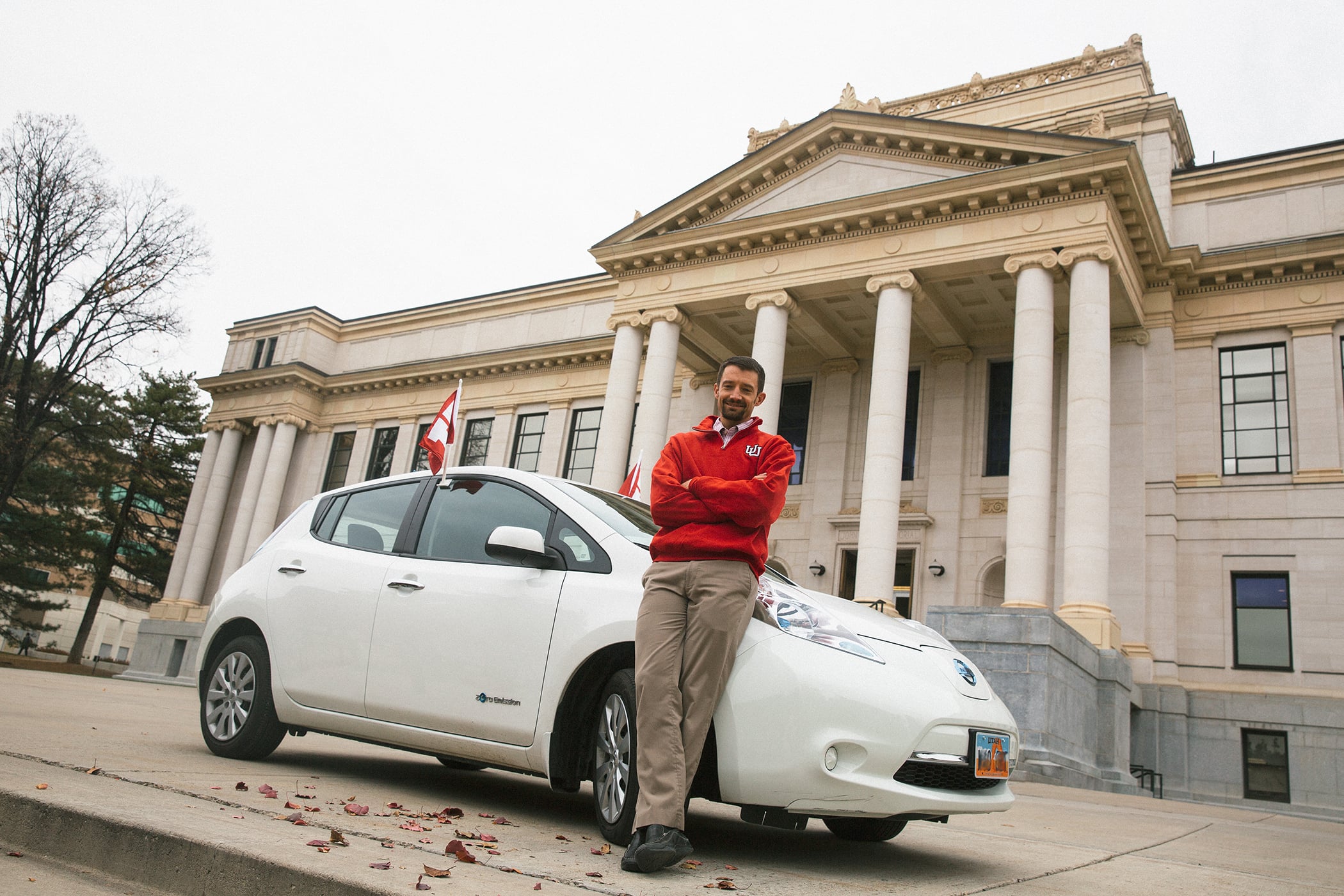
Community electric cars come to University of Utah

u-electric

Exciting news from our friends at the University of Utah today! They have announced a new bulk purchase program that offers steep discounts on an array of electric vehicles. Read on for details – SLCgreen

The University of Utah is the first university in the country to sponsor a community-level electric vehicle purchase program that includes discounts on multiple makes and models.

U Community Drive Electric offers members of the U community, including faculty, staff, students, alumni and campus guests in Salt Lake, Summit, Weber, Tooele, Utah and Davis counties, the opportunity to purchase or lease electric vehicles at a discount of 5 percent to 20 percent off of MSRP. The limited-time program launches today, Dec. 14, and runs through Dec. 31, 2015.

Car dealers are able to offer a discount because these types of community programs tend to generate more customers in close proximity during a specific timeframe. There are three participating car dealers: BMW of Murray, Larry H. Miller Ford Lincoln – Sandy and Tim Dahle Nissan of Murray.

There will be a community workshop with questions and answers, Thursday, Dec. 17, 6-7:30 p.m. at the University of Utah Spencer Fox Eccles Business Building on the 7th floor, 7170.

This program is part of the university’s goal to implement creative solutions to lessen its environmental impact and to improve conditions for the community and future generations. With almost 50 percent of Utah’s urban air pollution coming from tailpipe emissions, electric vehicles represent an important tool for improving air quality along the Wasatch Front.

“We are excited to support U community members’ access to emissions-reducing cars that will improve air quality,” said University of Utah Chief Sustainability Officer Amy Wildermuth.

To offer this incentive, the Sustainability Office is partnering with Utah Clean Energy, a nonprofit, public interest organization that works to drive the transition to a clean energy future. The program is enabled by a generous grant from Utah Clean Air Partnership, or UCAIR, which encourages businesses, government agencies and nonprofit organizations to invest in emissions-reducing and energy-efficient technologies.

“This is a terrific program recognizing the positive impact electric cars can have on air quality,” said UCAIR Director Ted Wilson. “I congratulate the University of Utah and Utah Clean Energy for forming a strong program making electric cars more economical to buy. Once owned, they are clean and simple with almost no maintenance. In other words, both economically smart and a fine contribution to better air.”

“The support of UCAIR is key to U Community Drive Electric,” said Wildermuth. “This unique opportunity will allow individuals to make a meaningful difference for our local community and will serve as a model to others for what is possible. Reducing tailpipe emissions is just one of the many ways we are working to improve local air quality. With UCAIR support and partnership with Utah Clean Energy, we hope to help make a significant contribution.”

In addition to increasing awareness about electric vehicles’ impact on Utah’s air quality, the organizers of U Drive Electric hope to connect the benefits of combining solar power with electric vehicles.

“Fully electric vehicles have no tailpipe,” said Utah Clean Energy Executive Director Sarah Wright. “They eliminate 99 percent of the smog-producing volatile organic compounds, carbon monoxide and sulfur dioxide emitted by gas-fueled cars in our airshed. And when powered by solar energy, they are truly pollution free.”

U Drive Electric will also include plug-in hybrids to provide an opportunity for people who require a longer-range option to participate in the program. Including these vehicles maximizes the choices for consumers, which will ultimately help even more community members reduce their pollution.

Participating community members will sign up for the program with Utah Clean Energy at www.udriveelectric.org. Once registered, participants work directly with any of the selected dealers to purchase the electric car of their choice. Participants must sign a contract before Dec. 31, 2015, to guarantee the discount.

For more information about the U Community Drive Electric program, visit www.udriveelectric.org.

About Sustainability at the University of Utah
The University of Utah is committed to integrating sustainability across all areas of the institution, including academics, operations and administration. Additionally, the university is supporting sustainability efforts and research under the Sustainability Office to better streamline initiatives and collaboration across campus.

About UCAIR
UCAIR is a statewide clean air partnership created to make it easier for individuals, businesses and communities to make small changes to improve Utah’s air quality. Every small change adds to a collective bigger step toward better health, a better economy and better overall quality of life for all of us.

About Utah Clean Energy
Utah Clean Energy is Utah’s leading expert public interest organization working to expand renewable energy and energy efficiency in a way that is beneficial not only for Utah’s environment and health, but also our economy and long-term energy security. Utah Clean Energy is committed to creating a future that ensures healthy, thriving communities for all, empowered and sustained by clean energies such as solar, wind and energy efficiency.

Green Thanksgiving Ideas

1. Planning your holiday menu? What better place to do your Thanksgiving shopping than at the pre-Thanksgiving edition Winter Market at the Rio Grande, Saturday, November 21st? Feature local food on your table this season. Utah growers will be selling holiday staples: onions, potatoes, carrots, winter squash, pumpkin, apples and more!

2. Try Vegducken, a delicious and beautifully layered vegetarian entrée.

EP_10072015_thanksgiving_vegducken

Here are some great additional vegetarian recipes!

3. Resist the urge to use disposable table settings.  Have a dish-washing party with your guests.  Many hands make work light!

4. Be creative with leftovers! Share them amongst guests. Re-purpose them into sandwiches and soups!  Use re-usable containers for storage.

5. Compost and recycle.  Remember plant based food scraps can go in the brown compost can!

Have a wonderful Thanksgiving.

Climate Week: Local Climate Action Receives National Attention

ClimateWeek-Web-2

Under Mayor Ralph Becker’s leadership, Salt Lake City has taken a proactive approach to climate preparedness and resilience. Learn more about the City’s accomplishments and goals on SLCgreen.com.

And that local action has been receiving some national attention! Recently, the White House and U.S. Department of Energy designated Salt Lake City as a Climate Action Champion community. A total of 16 U.S. communities were recognized as inaugural Climate Action Champions.

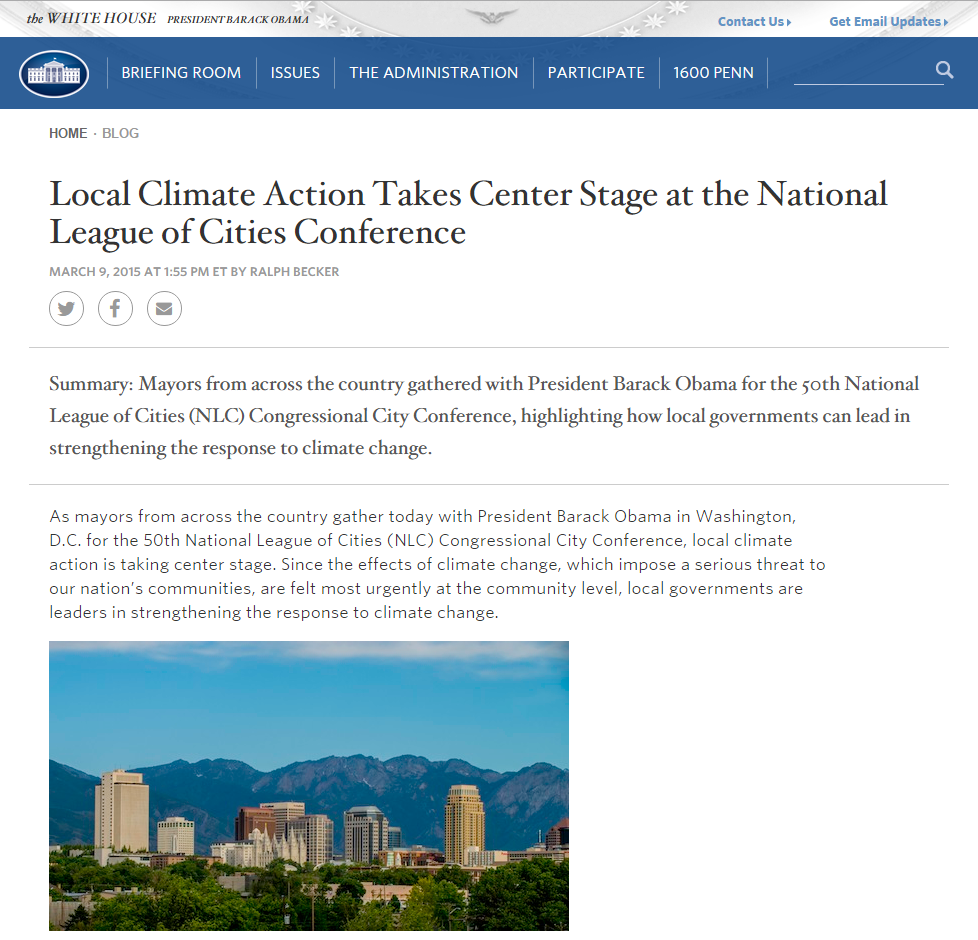
In March, Mayor Becker was invited to contribute to the White House Blog, touting the progress made right here in Salt Lake City as a national example of success. View “Local Climate Action Takes Center Stage at the National League of Cities Conference.

White House blog image

Climate Week: What SLC is Doing to Combat Climate Change

ClimateWeek-Web-2

Salt Lake City has been recognized as a Climate Action Champion for showing leadership on climate change. The accomplishments of Salt Lake City in the past seven years demonstrate a commitment and successful track record of innovation and leadership to integrate the reduction of greenhouse gas (GHG) emissions and enhance climate resilience into local and regional planning and decision-making.

Here are some of the City’s climate actions, goals, and key initiatives:

Joint Resolution To Reduce Carbon Footprint. Mayor Ralph Becker and the Salt Lake City Council signed a joint resolution in 2008 committing the City to reduce its municipal carbon footprint 20% below the 2005 level by 2020; 50% below the 2005 level by 2040; and, 80% below the 2005 level by 2050.

Community Greenhouse Gas Inventory. The City completed its first community GHG inventory in 2009, which quantified 4.75 million metric tons of carbon dioxide equivalent (CO2e) emissions – or 26 metric tons per person – and prompted the City’s commitment to eliminate 1.3 million metric tons of CO2e by 2020. The City also has a goal for reduction of GHG emissions in the community by 80% below the 2005 level by 2050.

Clear the Air Challenge. The City created the Clear the Air Challenge to engage citizens in voluntary reductions in vehicle miles traveled, resulting in the elimination of over 9.5 million single-occupant vehicle miles traveled and reducing more than 7.5 million pounds of GHG emissions between 2009 and 2014.

Salt Lake City Sustainable Code Revision. The Salt Lake City Sustainable Code Revision project is a ground-breaking initiative to incorporate sustainability provisions into zoning and subdivision ordinances.

Salt Lake City Energy and Transportation Sustainability Plan. The Salt Lake City Energy and Transportation Sustainability Plan (2011) details strategies for the City to contribute to climate resilience, cleaner air, greater energy security, a green energy economy, and protection of our water supply, wildlife, and other natural resources. Salt Lake City Energy and Transportation Sustainability Plan goals include:

  • Decrease total building energy use in the city by 5%, to 35 million MBTUs by 2015
  • Transform all City government buildings into net-zero facilities
  • Increase renewable energy generation on City facilities to 2.5 megawatt by 2015
  • Generation of 10 megawatts of solar energy in the community by 2015
  • Reduction of vehicle miles traveled by residents by 6.5% by 2015

Salt Lake City Public Safety Building. The City’s $125 million Public Safety Building is the first public safety building in the nation constructed to achieve Net Zero energy use due to the use of multiple innovative energy efficiencies and solar-photovoltaic (PV) technologies.

Livability in Salt Lake City 2012-2016. Mayor Becker published his agenda, Livability in Salt Lake City 2012-2016, to frame a broad vision of local climate response goals, strategies, and actions that lead to greater resiliency, vitality, accessibility, sustainability, and diversity further distilled in the Sustainable Salt Lake Plan 2015.

Sustainable Salt Lake – Plan 2015. The Sustainable Salt Lake – Plan 2015 (Plan 2015) grounds the City’s broad and ambitious climate response strategy with goals, key metrics, and milestones related to air quality, energy, transportation, water resources, urban forestry, and open space. Sustainable City Dashboard. The Sustainable City Dashboard is an innovative new online tool to track key metrics and milestones associated with the Plan 2015 and promote an increased level of public engagement and feedback on climate response initiatives.

To learn more about Salt Lake City’s climate actions, visit SLCgreen.com!

The University of Utah Explores Society, Water and Climate

The Utah College of Social and Behavioral Science hosted an intriguing breakfast presentation last Friday at the Red Butte Garden Classroom on the topics of Society, Water, and Climate.

12063456_10153048418631363_7371705734370122207_n

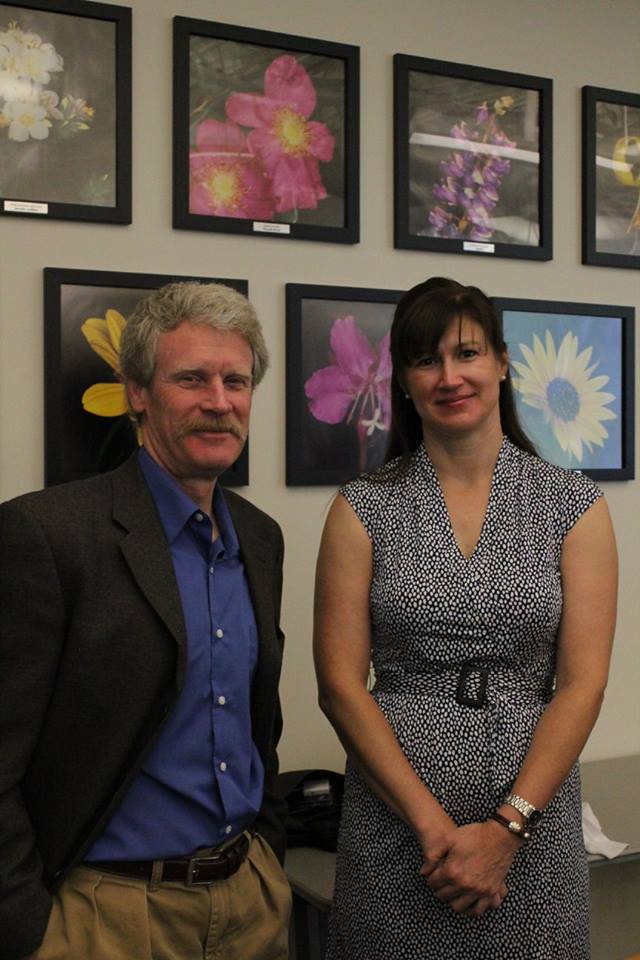
Drs. Rick Forster and Andrea Brunelle. Photo credit: Annette Barrett, University of Utah.

Drs. Rick Forster, Associate Dean for Research in the College of Social and Behavioral Science, and Andrea Brunelle, Geography Chair, presented on the University of Utah’s new interdisciplinary faculty cluster, an effort to focus research and use a multifaceted approach to addressing challenges related to society, water, and climate. The new faculty cluster includes an ecohydrologist, an air quality scientist and a glaciologist. The addition of a social or behavioral scientist is forthcoming. “This transformative cluster connects research on hydrology, air quality, climate change, societal response, and policy, seeking to meld multiple scientific perspectives to lead society towards sustainable water solutions in a changing world.” (Society, Water, and Climate)

12065722_10153048418316363_4935383951724763899_n

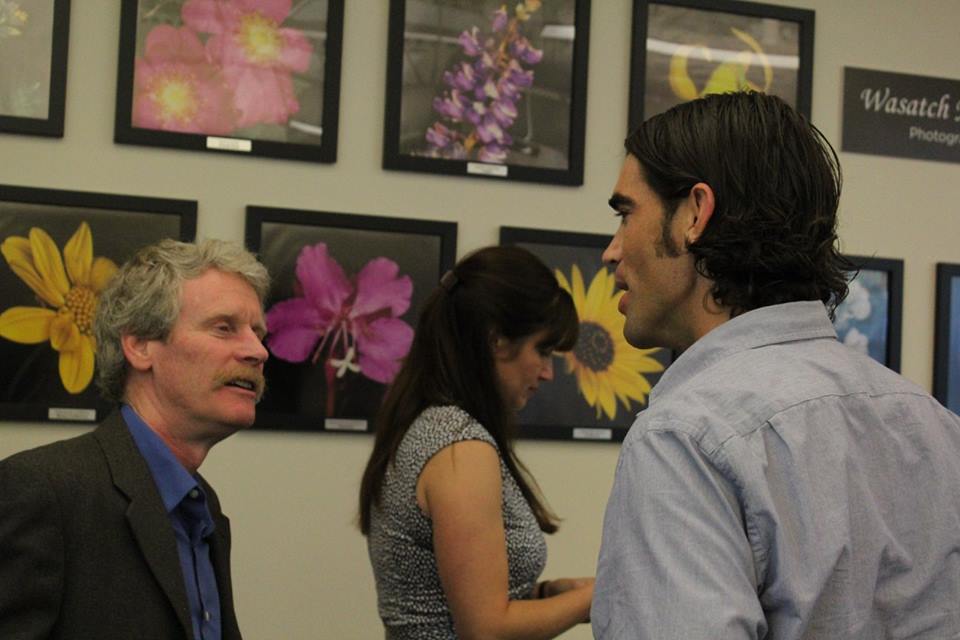
Dr. Rick Forster and Tyler Poulson, SLCgreen Photo credit: Annette Barrett, University of Utah.

Drs. Rick Forster and Andrea Brunelle also shared experiences and some great photos from their own field-based research.  Dr. Forster studies glaciers and seasonal snow cover response to climate change. He showed some incredible footage of dripping water, despite air temperatures well below freezing, found when ice cores were lifted to the surface at a research site in Greenland.  The water had come from a perennial aquifer under Greenland’s Ice Sheet.

“Climate change will bring increased temperatures combined with likely increases in the severity, frequency, and duration of weather extremes, such as droughts and floods. Changes in water availability due to climate change will be further complicated by use of water for agriculture, changes in land use, and population growth. In many regions of the world, issues centered on climate change and water availability will profoundly shape society in the next century. Addressing these issues requires a focused, transdisciplinary effort from scientists with expertise in society, water and climate.” (The Theoretical Framework of the Society, Water and Climate Research Cluster)

This collaborative approach is an important piece in finding sustainable solutions to issues of society, water, and climate in the future.

Mayor Becker Signals Support for Stronger Clean Air Protections


airquality

SALT LAKE CITY – Today, Salt Lake City Mayor Ralph Becker released a letter signed by more than 50 U.S. mayors from around the country signaling support for President Obama setting the strongest possible clean air protections against smog pollution, also known as ground-level ozone.

“Poor air quality is one of the most significant threats to our quality of life here in Salt Lake City,” said Mayor Becker. “Stronger smog protections will help our families breathe easier and spend more time outdoors, without having to worry about the quality of the air we breathe.”

According to the American Lung Association, inhaling smog pollution is like getting a sunburn on your lungs and often results in immediate breathing trouble. Long term exposure to smog pollution is linked to chronic respiratory diseases like asthma, reproductive and developmental harm, and even premature death. Children, seniors, and people with asthma are especially vulnerable to smog’s health impacts.

Salt Lake City is taking action to reduce its impact on air quality by increasing electric vehicle infrastructure, reducing fleet tailpipe emissions and replacing two-stroke maintenance equipment with more efficient models. Explore all of the actions Salt Lake City is taking to reduce air pollution at www.SLCgreen.com.

The letter was signed by a diverse coalition of local leaders and supports efforts by President Obama and the U.S. Environmental Protection Agency to stay true to the science and issue protections consistent with the recommendations from leading public health organizations like the American Lung Association, the American Academy of Pediatrics, and American Health Association.

Media Contact:

Kate Lilja Lohnes
Communications Manager
Salt Lake City, Division of Sustainability
(801) 535-7755


Eat Local Week

Eat Local Week is quickly approaching!  The week of September 12th-19th will be filled with local food events where your participation is strongly encouraged!  A significant part of Eat Local week is the Eat Local Challenge, a fun and exciting way to get a better understanding of where your food comes from. The Challenge is simple, eat as local as you can.

What is local? Try for food within 250 miles from your home. Why?  There are a myriad of reasons.  Eating locally enhances the local economy. Every dollar spent at a locally generates $2.80 of economic activity for our community.  Supporting local farmers has a multiplier effect throughout the local economy as a whole. Local farms generate jobs for the community, farmers’ markets bring customers to surrounding businesses, and they support farmers who are likely to spend money locally on agricultural supplies. (1)  In our conventional food system, farmers receive an average of 20 cents of each dollar spent on food. In a direct-to-consumer market like a farmers’ market or CSA (community supported agriculture share), the farmer receives the direct profit. (2)

Smaller family farms are often more sustainably run than large industrial or factory farms.  “Industrial farming negatively impacts the environment in myriad ways (e.g., by polluting the air, surface water, and groundwater, over-consuming fossil fuel and water resources, degrading soil quality, inducing erosion, and accelerating the loss of biodiversity).  Many small-scale, local farms attempt to ameliorate the environmental damage done via industrial farming by focusing on sustainable practices, such as minimized pesticide use, no-till agriculture and composting, minimized transport to consumers, and minimal to no packaging for their farm products.” (1) Small farms typically grow a variety of crops, adding variation to protect biodiversity and preserve a larger agricultural gene pool. (2)  Local growers can tell you how the food was grown. There is an accountability piece with buying locally produced food, where you can talk directly to farmers and ask about sustainable practices used to grow and harvest the crops.

Fresh food and food that is in season tastes better!  Local food is often more fresh and harvested closer to peak ripeness, with packing, shipping, and shelf-life stages removed.  This contributes to quality and flavor.  On average, in the United States, food travels about 1500 miles from farm to plate.  “Fresh food tends to have more nutrients than food that was picked days or weeks ago,” says Michael Pollan, author of “Food Rules: An Eater’s Manual.” (1) Enjoy Utah’s local food this Eat Local Week!

To learn more about eating locally, visit Eat Local Week Utah’s website.

(1) Grace Communications Foundation.  Local and Regional Food Systems. http://www.sustainabletable.org/254/local-regional-food-systems Accessed Sept. 2, 2015.

(2) Project Open Hand. The Benefits of Eating Locally Grown Foods. http://www.openhand.org/2011/07/20/the-benefits-of-eating-locally-grown-foods/ July 20, 2011.

Off Broadway Community Garden Celebration

Today we celebrated the opening of Salt Lake City’s newest community garden, Off Broadway Community Garden.  Media representatives and residents joined Mayor Ralph Becker, Alex Eaton of the Community Foundation of Utah, Ashley Patterson of Wasatch Community Gardens, and Abby Bluth of Off Broadway Community Garden for the celebration.

“Salt Lake City recognizes the high demand for community gardens in our downtown core, which highlights their importance in building a strong local food system,” said Mayor Becker. “The Off Broadway Community Garden project, located in a neighborhood with a two-year waiting list for garden plots, now provides 30 more city residents the opportunity to grow and enjoy fresh organic produce.”  Here’s a link to a great video of Mayor Becker’s speech!

Last year, Salt Lake City’s Green City Growers program was awarded $50,000 in grant funds to support the development of two new community gardens, including the Off Broadway Community Garden. The award included $25,000 from the Local Sustainability Matching Fund, a Partners for Places project of the Funders’ Network for Smart Growth and Livable Communities. The Community Foundation of Utah provided the $25,000 grant match and will manage permanent endowments.

“We are committed to sustainable nonprofits and sustainable communities, and this project is a demonstration of both,” said Alex Eaton, Executive Director of the Community Foundation of Utah. “We are proud to support this project, which increases access to healthy food and strengthens our local community.”

Salt Lake City works directly with Wasatch Community Gardens and community members to develop gardens within City limits. Wasatch Community Gardens is a community-based nonprofit that has served Salt Lake County for over 25 years.

For more information on the Green City Growers Program, which provides City owned/managed land for the development of community gardens, please visit www.SLCgreen.com.

News links:

KUER News: http://kuer.org/post/slc-community-gardeners-struggle-meet-demand#stream/0

SLC Mayor’s Office: http://www.slcmayor.com/read/2015/8/24/mayor-becker-community-partners-to-announce-new-downtown-community-garden

Inspiring Outdoor Stewards

Salt Lake City was selected as one of the first 50 cities to participate in a nationwide movement to inspire and encourage young people to experience the outdoors.  U.S. Department of the Interior Secretary Sally Jewell joined Mayor Ralph Becker, Vice President and General Manager of American Express Salt Lake City Victor Ingalls, and President and CEO of the YMCA of Northern Utah Rich West to announce grants totaling $258,653 to organizations throughout Utah, including the Utah Conservation Corps, Grand Staircase Escalante Partners, River Restoration Adventures for Tomorrow, and American Conservation Experience.

“For the health of our economy and our nation’s public lands, it’s critical that we work now to establish deep, meaningful connections between young people – from every background and every community – and America’s great outdoors.” -Interior Secretary Sally Jewell.

The initiative, funded as part of a $5 million national commitment by the American Express Foundation, will provide two years of funding for the YMCA of Northern Utah to create a community coordinator position to facilitate collaboration, grow resources, and increase participation in outdoor programs on all public lands in Salt Lake City, from local parks to federal lands and waters. The funding will also support efforts to engage young adults and veterans to serve on the 21st Century Conservation Service Corps and engage new volunteers during next year’s National Park Service Centennial.

“When young people are given an opportunity to care for public lands, their experiences often inspire lifetime connections to their backyard parks and beyond,” said Secretary Jewell. “Volunteering opens doors to new and exciting career opportunities that can transform the personal lives of youth while benefiting the communities and special places they work to improve.”

“Salt Lake City is home to one of the most beautiful natural settings in the country and we couldn’t be more thrilled by this news. Our children benefit enormously from spending more time in nature, and this new funding will help us expand our work in Salt Lake City to help increase the amount of time our kids spend outdoors.” – Mayor Ralph Becker.

Victor Ingalls, American Express Vice President and General Manager in Salt Lake City said, “Since our founding more than 160 years ago, American Express has seen how America’s parks and public lands contribute to our sense of national and local identity, and we are proud to lead an effort to mobilize a new generation of volunteers to protect, conserve and revitalize America’s public lands and treasured national parks.”

“Many people in our urban neighborhoods don’t always have the chance to experience all that our public lands in and around the city have to offer,” said Rich West, President and CEO of the YMCA of Northern Utah. “This initiative will help us bring together leaders in conservation, education, recreation and service to provide opportunities to deepen connections to these natural and historic sites, develop important skills, and engage in activities where they can give back and strengthen our community.”

The movement is part of First Lady Michelle Obama’s Let’s Move! Outside initiative and part an overall strategy by the Obama Administration to connect young people to the outdoors. Other efforts include the President’s recently announced Every Kid in A Park initiative to provide all fourth grade students and their families with free admission to national parks and other public lands and waters for a full year, and the National Park Service’s Find Your Park campaign preparing for next year’s centennial of the National Park System.

For more information about the initiative, visit: www.doi.gov/youth

Source: U.S. Department of the Interior, Press Release, “Interior Department Selects Salt Lake City as Priority City to Connect Youth to the Great Outdoors,” August 6, 2015. http://goo.gl/uxued5


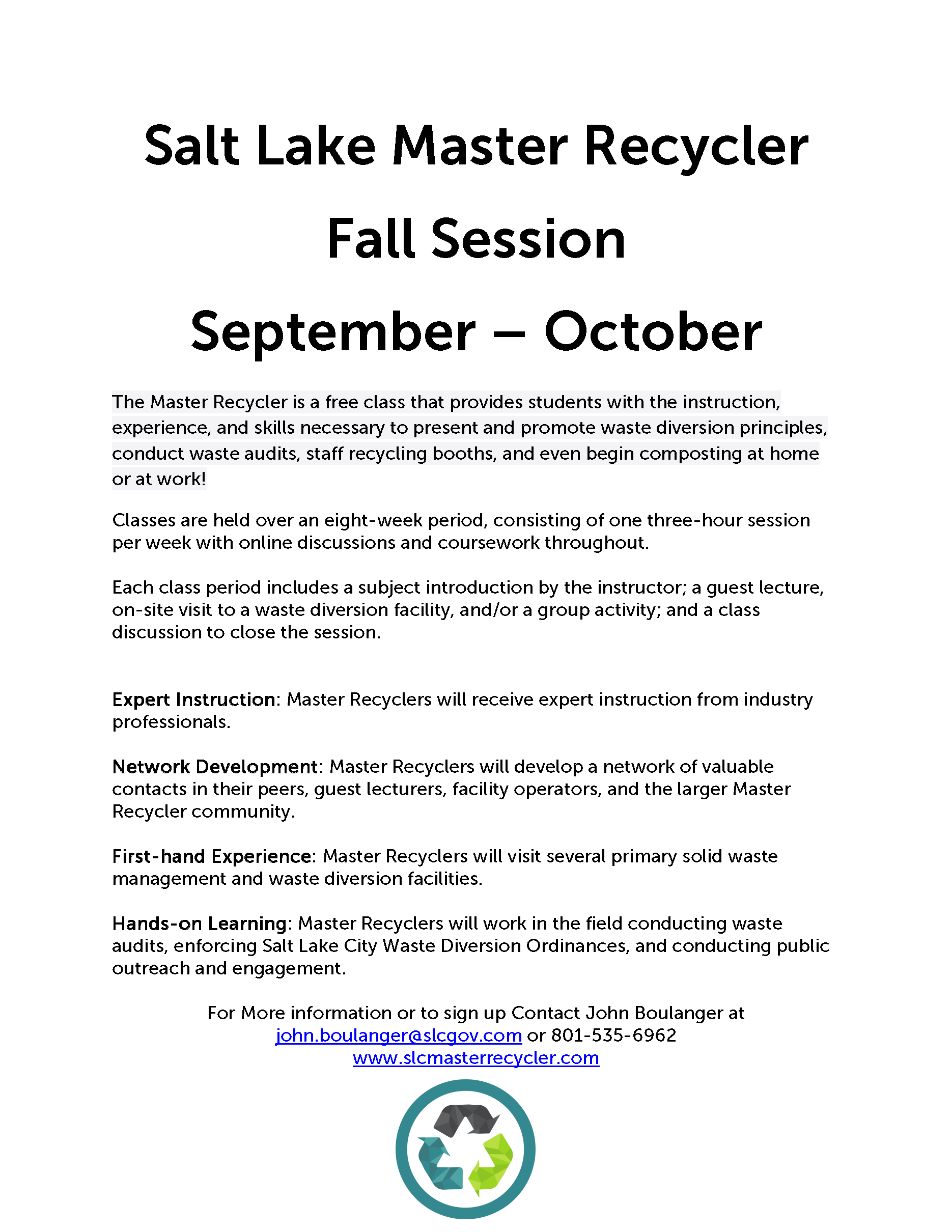
Master Recycler Fall Session

By Josh Lipman, SLCgreen Intern

After the first successful round of training members of our community to be experts in recycling, SLCgreen and the Department of Sanitation are opening up applications for the second round of the Master Recycler training program.

Participants in the Master Recycler program take a hands on approach to learning about sustainable waste management in Salt Lake City by studying and experiencing the most up to date recycling techniques through classroom sessions and visits to the different waste management and recycling facilities in our city. Master Recyclers then can educate and engage the community, creating a network of environmentally consciousness Salt Lake City residents.

The fall Master Recycler class runs eight Thursdays from September 3rd to October 22nd. Applications are rolling and through August 28th (dates subject to change), and the class is free of charge. All community members are encouraged to register and come learn about these key systems in the city by emailing John Boulanger at john.boulanger@slcgov.com.

Salt Lake Master Recycler Fall Flyer