Tag Archives: air quality

World Urban Forum 7

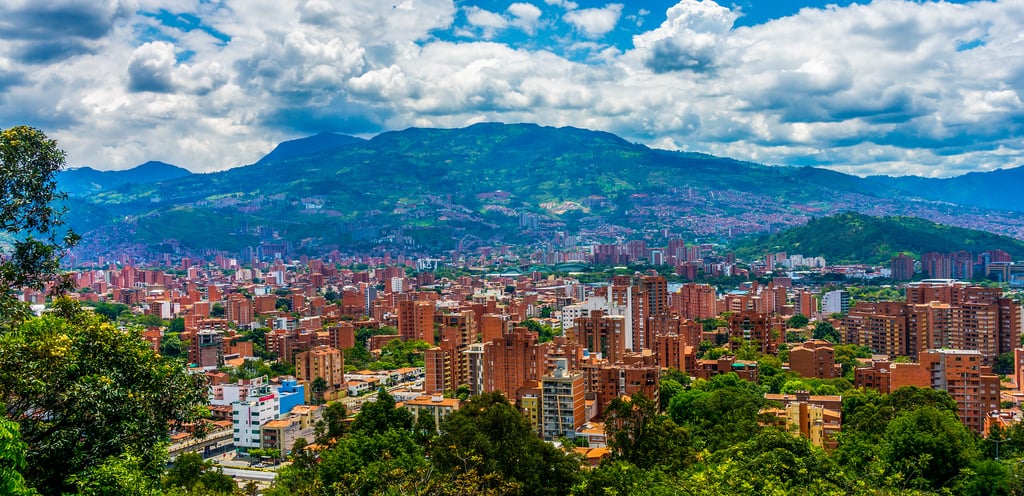
Medellin, Colombia. BorisG via Flickr

Medellin, Colombia. Photo BorisG via Flickr

Salt Lake City is excited to participate in the World Urban Forum, hosted by UN-Habitat this April in Medellin, Colombia.

The City will participate in a special networking session called “Clean Energy and Transport Solutions in an Urban Hemisphere: Lessons from the Americas.”

Over the past few months, Salt Lake City has been collaborating with San Jose, Costa Rica to share experiences & lessons learned from the two cities’ alternative transportation programs. During the session, the City will share our lessons learned from running the Clear the Air Challenge and the “twinning” process with San Jose.

The session is the result of a partnership between the US Environmental Protection Agency (EPA) and Organization of American States (OAS). Learn more about the forum below, or on the OAS website. 

We’ll be updating the @SLCgreen Twitter feed live from the World Urban Forum (#wuf7) from April 7-11. Stay tuned to stay in the loop!

save-the-date-wuf7_small

Air Quality Bills: 2014 Legislature Wrap Up

clouds

The community had high hopes for meaningful action during the 2014 Utah Legislative Session on air quality. With the session now at an end, our friends at the Utah Department of Environmental Quality posted a nice summary of the bills that passed.

Here’s a quick overview, head over to their newsletter for the full story.

State Fleet

Legislators directed the Division of Fleet Operations to ensure that 50 percent or more of the state vehicles used to transport passengers will be alternative fuel or high-efficiency by August 30, 2018. View the bill.

Electric Vehicles

A House bill amended the current definition of public utilities to encourage businesses to provide charging stations for electric cars. Another bill provides a state income tax credit of $1500 for the purchase or lease of a new electric vehicle and a tax credit allowance for a plug-in electric hybrid. View the bill. Legislation modified The Clean Fuels and Vehicle Technology Act to allow electric-hybrid vehicles to qualify for funding for alternative refueling infrastructure. View the bill.

Wood Burn Program

The Division of Air Quality received funding to educate the public about the dangers of wood smoke and help convert homes whose sole source of heat is wood to natural gas or other clean fuels. View the bill.

Medical Waste Incinerators

A Senate bill banned the incineration of medical waste within close proximity of a school or residential subdivision. View the bill.

Retrofit and Replacement Program

This program will help small businesses and individuals by providing grant and loan funds for emission-reducing technologies, including retrofits, repowers, and replacements. The program will also encourage replacement of snow removal, landscaping, and other yard equipment with cleaner alternatives. View the bill.

Department of Environmental Quality (DEQ) Funding

The Department of Air Quality (DAQ) received a one-time, $1.4 million grant that allocated $1 million for Utah-specific air quality research, $300,000 for an inventory and photochemical modeling study in the Uinta Basin, and $100,000 for volatile organic compound (VOC) infrared testing equipment. DAQ also received $400,000 in ongoing funding for four full-time employees to work on Uinta Basin oil and gas permitting and compliance.

The legislature appropriated $500,000 to DEQ for an air quality public awareness campaign in partnership with existing clean air programs such as UCAIR and TravelWise. DAQ received a one-time, $500,000 appropriation to help convert homes that burn wood as their sole source of heat and a one-time, $250,000 grant to educate the public on the hazards of wood smoke. The Clean Air Retrofit, Replacement, and Off-road Technology (CARROT) program received a one-time grant of $200,000 for grants and loans to small businesses and individuals seeking to reduce the emissions from their heavy-duty diesel or small-engine equipment.

Get the DEQ Newsletter

Get the full scoop from the DEQ newsletter and join their email list.

Students Who Care About the Air Contest


Calling all Utah students who care about the air!

Share your ideas for ways to educate your friends and family about being idle free and be eligible for cash prizes. Students are encouraged to submit their essays, photos, videos or artwork.

Entries are due on or before March 5, 2014. More details and entry submissions are available at StudentsWhoCareAbouttheAir.com.

We love it! Get creative, kids…

air_contest 21

Mayor to Host Community Conversation on Air Quality Issues

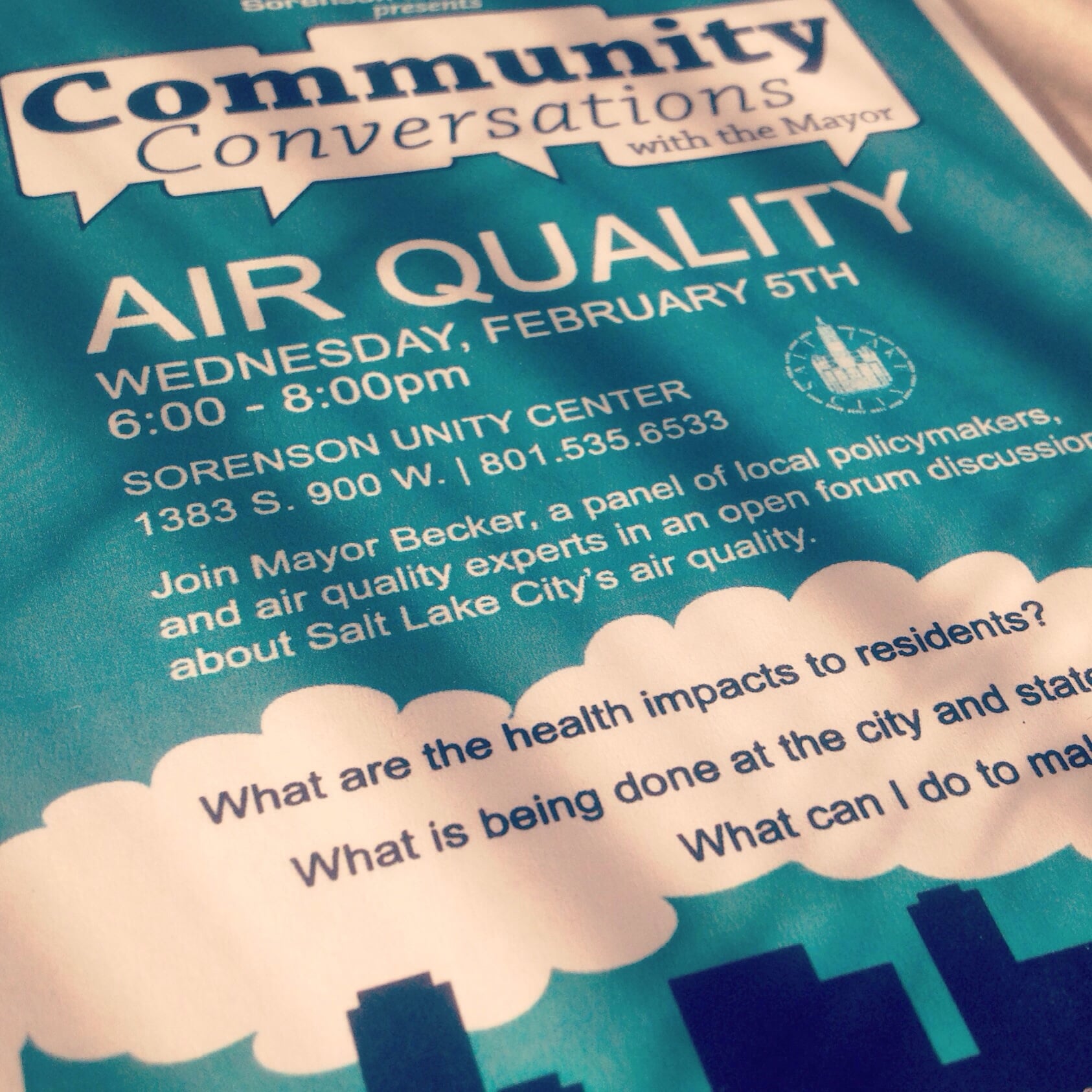
Mayor Ralph Becker invites residents to join him and a panel of local policymakers for an informal community conversation about air quality issues on Wednesday, Feb. 5 from 6-8 p.m. at Sorenson Unity Center, 1383 S. 900 West.

Mayor Becker reiterated his commitment to working toward addressing the region’s ongoing air quality issues in his recent State of the City Address and outlined air quality-focused work Salt Lake City has accomplished during his administration, City efforts planned for the year ahead and the critical areas that require action by Utah state leaders.

Attendees will have an active role in the discussion as Mayor Becker and panel members answer questions, outline what is happening at the local level to improve air quality and what community members can do to help make a difference.

Joining Mayor Becker will be Salt Lake City Councilman Kyle LaMalfa, Salt Lake City Councilwoman and Breathe Utah Executive Director Erin Mendenhall and Salt Lake City Sustainability Director Vicki Bennett.

“I look forward to this opportunity to explore air quality issues with our residents and brainstorm on ways we can work together toward positive change,” said Mayor Becker. “Improving our dreadful pollution problem is going to require a wide-ranging collaborative effort that includes definitive action by state government in addition to ongoing efforts by municipal entities and all of us who call Utah home.”

This event is the first in a series of monthly gatherings at Sorenson Unity Center focused on issues important to Salt Lake City residents.

EVENT: Community Conversations with Mayor Becker

WHO: Salt Lake City Mayor Ralph Becker
Salt Lake City Councilman Kyle LaMalfa
Salt Lake City Councilwoman and Breathe Utah Executive Director Erin Mendenhall
Salt Lake City Sustainability Director Vicki Bennett

WHERE: Sorenson Unity Center
1383 S. 900 West

WHEN: Wednesday, Feb. 5
6-8 p.m.

20140204-153712.jpg

Open Letter from Mayor Becker on Air Quality

Dear Friends and Colleagues,

As you may know, air quality has been a major focus of my work as mayor. My administration has been working on bringing greater attention to the issue and I’ve been advocating for aggressive, meaningful steps to that can be taken by Salt Lake City, state government, industry and individuals to help clean our air.

This is a complex problem and the only way we’re going to solve it is with a comprehensive solution. Let’s come together and fix this problem right away-we can’t wait, the time for talk is over, we need to take action.

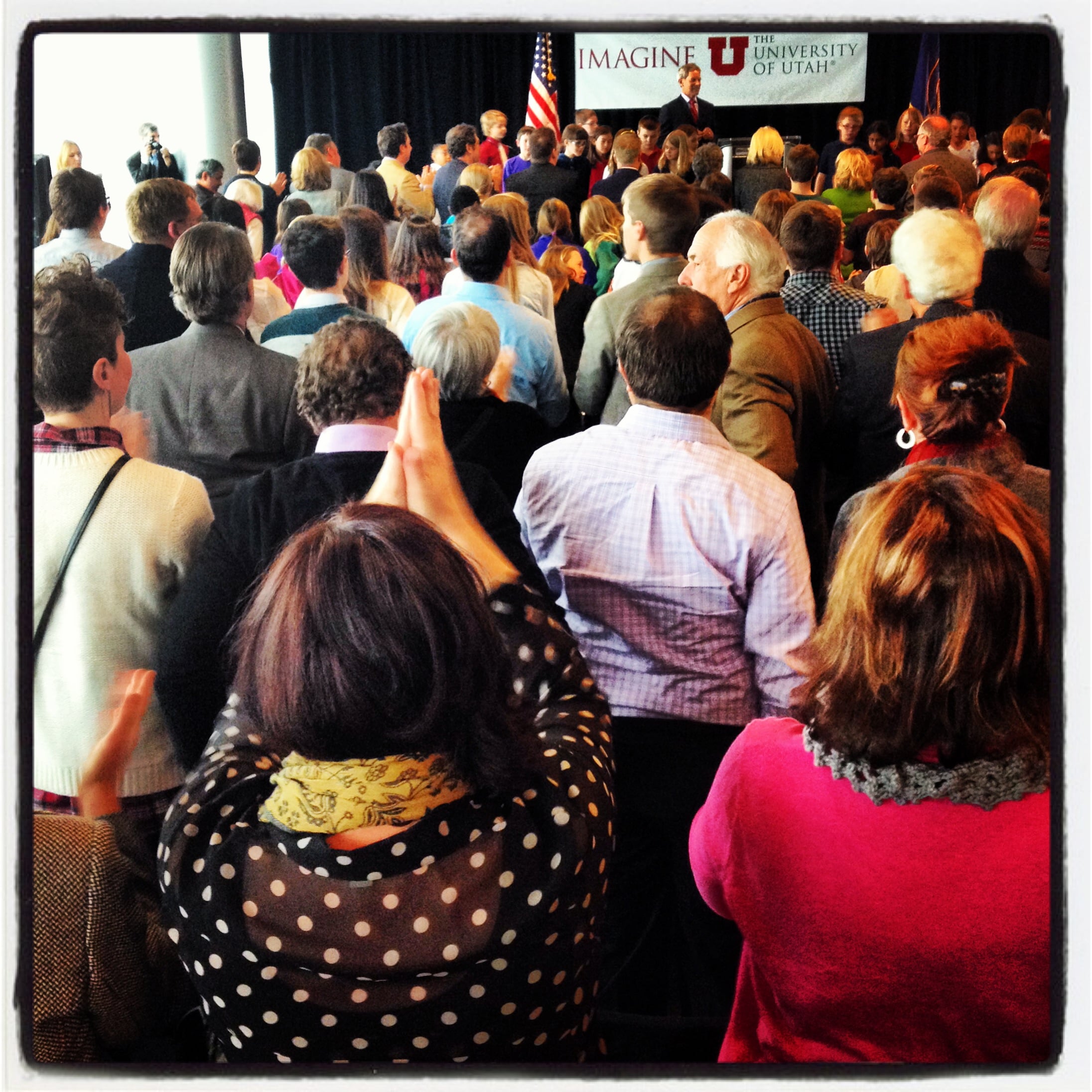
Mayor Becker delivers his State of the City address on air quality to a packed house.

Mayor Becker delivers his State of the City address on air quality to a packed house.

During my recent State of the City Address on solving the air quality problem, I proposed key actions that must be taken in order to accomplish this goal.

With clean air as our goal, Salt Lake City has adopted anti-idling ordinances, more than doubled our bike lanes and introduced the City’s first solar farm. For the upcoming year, we are launching the City’s first-ever multiple transit pass and are creating an incentive program to phase out wood burning stoves.

In addition to what Salt Lake City is doing, I’ve also outlined what the state ought to do. Those actions should include:

  • Allocating More Money for Public Transit
    • Increased funding for public transit in Salt Lake City would allow for buses and trains to run more frequently. We must make it more affordable and accessible for individuals to drive less and ride more.
  • Making Lower Sulfur Gasoline a Requirement
    • Tier 3 gasoline has lower levels of sulfur and therefore helps decrease emissions. It is widely available to us but is not required. Mandating that it be required would provide an immediate impact on our air quality.
  • Requiring Buildings to Use Power Efficiently
    • Utah’s energy code standards date back to 2006, lagging far behind many national and international standards. Adopting an updated building code for energy efficiency would help reduce energy use and improve air quality.
  • Making the True Cost of Driving Transparent at the Pump
    • Gas prices have a significant impact on how much people drive their cars. Raising the gas tax would help pay for better roads while also encouraging less driving and improving air quality.
  • Allowing Utah to set Utah-specific air quality standards
    • Setting air quality standards tailored to Utah’s needs is imperative if we are to improve our air quality. Generic national conditions will not work in Utah, and we need to set air quality standards that will work for us.

These are real solutions that will not only produce tangible differences, but produce them quickly. We have received a great response from the community, and are looking to turn that response into results.

If the state is unable to do these things for any reason, I’ve asked that they grant local governments the ability to make these changes because we will get it done at the local level. Enough is enough.

There are 2 things that I would ask of you in order to help improve our air quality.

  1. Lobby your legislators — Ask them to support these measures that I am bringing up and consider the other proposals that will clean up our air.
  2. If they do not support these measures, ask your legislators to grant authority to the local level, so that we can take care of our own problems. We can get this done on the local level if the state can’t or won’t.

I would also implore you to work with your legislators, and not against them. To be effective and to make real change, we need to work together in a respectful and civil manner. While it is important to let your voice be heard, it is equally important to do so in a manner which conveys respect and encourages cooperation.

One of the most memorable moments of my State of the City speech was when a class of 4th graders from Whittier Elementary School took the stage and sang a song they wrote about the inversion and what needs to be done. Our children are, at the end of the day, the most important reason we must strive to clean our air and these kids said it better than anyone could. Watch the video.

There has been enough talk, and it is time for action. A change must be made, and it is up to each and every one of us to make that change.
I hope you will join me in the fight to help improve the air quality of Salt Lake City.

Warm Regards,

Ralph Becker
Mayor
P.S. If you were unable to attend my State of the City address in person, the full text of the speech and some additional information about the issue can be found here.
Also the Salt Lake City Tribune ran a terrific op-ed that discusses the ideas I laid out in my air quality address and if you’re interested, you can read it here.
Special Event: The Air We Breathe

The-Air-We-Breathe

On Tuesday, February 4, KUED and a variety of community partners will come together for an evening to explore “The Air We Breathe.”

The free community event begins with a preview of “The Air We Breathe,” a locally-produced, 30 minute documentary that examines Utah’s air quality.

Attendees will also hear from Robert Grow, Executive Director of Envision Utah, and have a Q&A with University of Utah Program for Air Quality, Health & Society Director Dr. Robert Paine.

SLCgreen will be there, and we hope you will too!

The Air We Breathe Film Screening & Event
Tuesday, February 4
7:00 – 9:00 p.m.
University of Utah
Huntsman Cancer Institute, Auditorium (6th Floor)
RSVP to the Facebook event

Mayor Becker Takes on Air Quality

On Wednesday, January 8, Mayor Ralph Becker gathered with residents, students and stakeholders to deliver his 2014 State of the City Address.

But instead of following tradition and sharing the administration’s accomplishments, Mayor Becker focused his entire speech on air quality.

The Mayor began by focusing on what Salt Lake City has already accomplished to reduce emissions and help clear the air. Efforts include the City’s Idle Free Ordinance, bike share, electric vehicle charging stations, biking infrastructure and the new net zero Public Safety Building. Read the full summary.

Then he outlined Salt Lake City’s next steps on air quality issues, including discount transit pass for city residents, creating an incentive program to replace woodburning stoves and phasing out inefficient maintenance equipment like 2 stroke engines. Read the full summary.

In some of the most compelling moments of the address, Mayor Becker outlined five clear requests for state government. These requests specifically deal with limitations that local governments face when combating air pollution. Part of the plea included the message “If this can’t be accomplished at the state level, let us. We at the local level can get it done.”

  1. Allocate more money for public transit. “We have to make it easier for people to use transit as an alternative to driving. We need more coverage that runs more frequently and costs less. Recent polling and many anecdotes I hear reinforce how difficult it is for most people to use transit. It just takes too long and is too inconvenient. And the only way to improve transit service is to better fund it. I urge our State to raise the cap on sales tax for transit. It should be a no-brainer. Or, if you are unwilling to do so, let us do it. Give us local control to fund transit. We at the local level can get it done.”
  2. Make lower sulphur gasoline available. “Tier 3 gasoline, as it is called, has lower levels of sulphur and therefore decreased emissions. It is mandated in other states and should be required for use along the Wasatch Front. This technology exists today to significantly reduce tailpipe emissions. Interestingly, one of our local refineries, Chevron, already produces Tier 3 gasoline, but it is shipped to Washington State because it’s is required there. Even our Salt Lake County Council of Governments endorsed the shift to Tier 3. Or, once again, if you are not willing to do that, let us make that determination locally.”
  3. Change state law to allow for standards that are relevant to Utah. “Do you all know that we have a state law that says our air quality standards here in Utah cannot be more strict than federal standards? Are we really okay with a standard that represents a passing grade for most other cities and states, but still allows us to fail? Since when are we content with Federal officials in Washington determining what’s best for the people of Utah? If this can’t be accomplished at the state level, give us local control over air quality standards so we can make them fit our local needs.”
  4. Make the true cost of driving transparent at the pump. “Gas prices directly affect whether people drive their cars more or less. According to a recent statewide survey, about half of Utahns would reduce vehicle use if gas cost an additional 25 to 75 cents per gallon. And, at an additional $1 per gallon, nearly two thirds would reduce their vehicle use and find other ways to run errands, get to work, and live their lives. If this can’t be accomplished at the state level, let us. We at the local level can get it done, and in fact local governments are united around a proposal for a local option gas tax increase.
  5. Require buildings to use power efficiently. Utah’s energy code standards date back to 2006. Since then, national and international building codes have been upgraded and have been proven to achieve a 30% improvement in energy efficiency. Many other jurisdictions across America have done this already. If state entities cannot or will not, let us do it. We can get it done locally.”

The event closed with the 4th grade ELP students from Whittier Elementary singing an original song called “The Frightful Inversion.” Watch the video below!

Additional Resources

Read a full transcript of the 2014 State of the City Address.

View images on SLCgreen Instagram.

Join the conversation! Use the #clearupslc hashtag on Twitter and Instagram.

[VIDEO] Get Inspired to Clear the Air

‘Tis the season for New Years Resolutions.

While you’re revisiting resolutions to exercise, eat healthy and spend more time with those you love (a great way to start the new year!), consider making one more resolution — to help clear the air.

Through the winter Care to Clear the Air project (2010-2012), a series of videos captured the stories of residents making a resolution to limit their impact on air quality by driving less.

Watch the videos below to hear from people that have done everything from moving closer to where they work, to biking, carpooling and taking public transit.

Their stories will inspire you to make your own resolution to help clear the air!

Kyle LaMalfa shares his commitment to take public transit.

[youtube=http://www.youtube.com/watch?v=b-ThTQPBKEU&w=560&h=315]
Continue reading

5 Ways to Limit Your Impact During an Inversion

Winter inversion season is here (collective sigh) and the Salt Lake Valley is currently in the grips of it’s first official inversion.

While periods of poor air quality can feel overwhelming, we’re here to offer five simple things you can do to limit your impact and protect your health. As we all know, whatever we put into the air during an inversion, we’re stuck with. So every little bit helps! Continue reading

Utah’s New Air Quality Alerts

Say goodbye to the basic Green, Yellow and Red air quality days!

Utah’s Division of Air Quality has updated their air quality alert system to more clearly and precisely communicate about action days and health alerts related to Utah’s air quality.

Continue reading