Category Archives: Climate Change

Plastic Free July: Learn to Live Without the Plastic

By SLCgreen Intern Kellen Hunnicutt

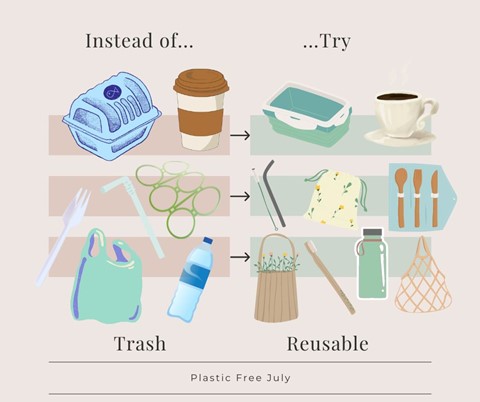
Graphic with two columns of images. Right "instead of" column has common single-use plastics trash of a plastic grocery bag, take-out fork and straw, plastic water bottle, and a to-go cup and containers Left "try" column has images of reusable items of a coffee mug, food container, cloth and net shopping bags, and reusable straws and utensils.

We live in a world that loves plastic. From grocery stores to coffee shops to our bathroom sinks, we see plastic pretty much everywhere. It makes sense. Plastic is lightweight, cheap, durable, and malleable, and in many cases, it serves an instrumental purpose. It keeps our food clean and safe from contamination, is ubiquitous in hospitals and clinics, enables home insulation and energy efficiency, and reduces the weight of cars, which saves gas.  

The problem is not these long-lasting or health safety-related uses of plastic. The problem is that we make and use a remarkable amount of unnecessary single-use plastic. Single-use plastics are items like bottled water, plastic grocery bags, and coffee cups that we throw out after only one use.

Continue reading

It’s Time To Clear The Air! 

by SLCgreen intern Charlie Bonkowsky 

Graphic reads: Take the Clear The Air Challenge July 2023 with a graphic of a mountain range and a clear blue sky

It’s almost time for The Clear The Air Challenge—an annual event encouraging Utahns to reduce their vehicle emissions and help keep Utah’s air clean! The competition starts on July 1st and runs throughout the month, with a goal this year of eliminating 100,000 single-car trips and keeping 375 tons of CO2 out of the atmosphere. 

Continue reading

Celebrate National Pollinator Week!

by SLCgreen Intern Emma Johnson

Image shows a butterfly pollinating a group of flowers

 
Pollinator Week is an annual celebration of the essential pollination services that bees, birds, bats, butterflies, and other insects provide. Pollination services are vital for agricultural success, general biodiversity, and overall ecosystem health. Pollinator numbers, especially insects, have been drastically falling for the past several decades. There is so much we can do to support our pollinators, but the first step is increasing awareness. Here is some information about pollinators in Utah and what you can do to help them: 

Continue reading

Salt Lake City and three other local governments award grants to four carbon dioxide removal projects

In October 2022, Salt Lake City joined the 4 Corners Carbon Coalition to support projects that will advance large scale carbon dioxide removal efforts and fight the climate crisis. A few months later, the Coalition reviewed and made selections among a competitive pool of projects. We’re excited to announce that $389k in funding was granted to four concrete production projects that will remove carbon from the atmosphere.

The projects are located in Colorado and Arizona, but we hope to encourage more innovation in this space here in Salt Lake City!

Why carbon dioxide removal as a strategy municipalities should suport?

We know that energy intensive industrial operations are a major culprit of carbon dioxide pollution and climate change. It may come to a surprise, however, that the cement industry alone is responsible for nearly 7% of the world’s emissions, and the global demand for concrete is expected to increase for decades to come, according to the The United Nations Economic Commission for Europe (UNECE), making this an important sector to decarbonize.

Thankfully, the 4 Corners Carbon Coalition was able to grant funding to four projects that are exploring innovative ways to create concrete while actually removing carbon dioxide from the atmosphere. There is huge potential for these types of projects to go large scale and be replicated around the globe.

To learn more about the 4 Corners Carbon Coalition and the funded projects, check out the press release below and this TechChrunch feature.


PRESS RELEASE

March 7, 2023

Innovation grants awarded to four concrete production projects that will suck carbon from the atmosphere

Coalition of local governments aims to spur carbon dioxide removal efforts, fight climate crisis through this funding

A coalition of cities and counties in the Western United States has awarded $389k in funding to four projects that fight climate change by removing carbon dioxide from the atmosphere through the production of concrete. The 4 Corners Carbon Coalition — a partnership of Boulder County, CO, Flagstaff, AZ, Salt Lake City, UT, and Santa Fe, NM — pools resources to provide grants to accelerate carbon dioxide removal (CDR) project deployment and business development in the Four Corners region.

Through a competitive application process, the coalition received nearly $800k in funding requests before selecting four organizations for grants: CarbonBuilt, Citizens for Clean Energy Inc., Minus Materials, and Travertine Technologies. Recipients of the coalition’s inaugural round of catalytic grant funding will support projects that integrate CDR with real-world concrete production.

During the selection process, a panel of international experts in climate research, CDR technology, and concrete and construction materials reviewed proposals. The panel  evaluated local replicability, potential for scaling, carbon removal volume, and benefits to workforce, justice, health, and ecology.

“The 4 Corners Carbon Coalition is a shining example of how local governments are acting together to fight the climate crisis,” said Susie Strife, Director of Boulder County’s Office of Sustainability, Climate Action & Resilience. “Pooling resources can amplify innovation and the creative deployment of the integration of carbon removal and concrete. These awardees will turn their breakthroughs into real world projects right here in the Western United States and we are thrilled to provide seed funding to catalyze this work.” 

“We couldn’t be happier with the quality of the applications received,” said Nicole Antonopoulos, Director of the City of Flagstaff Sustainability Office.  “It was just over three years ago that our community, like hundreds of others around the nation and the globe, called for the formal declaration of a Climate Emergency and outlined the goal of carbon neutrality.  In doing so, the Flagstaff community also made it clear that avoidance-based offsets would not satisfy. As such, we’ve worked to establish partnerships to begin to develop a portfolio of regional projects that support the development and deployment of meaningful carbon removal.  These projects do just that, and this outcome would not have been possible without Boulder County, Flagstaff, Salt Lake City and Santa Fe all working together as partners.”

CDR describes processes that pull carbon dioxide out of the atmosphere and lock it away in geological, biological, and synthetic formations for decades, centuries, or even millennia. Carbon dioxide removal is necessary because carbon dioxide reduction alone will not address the climate crisis. According to the United Nations Intergovernmental Panel on Climate Change (IPCC), cutting emissions from fossil fuels is necessary, but it’s no longer sufficient to stem the worst effects of climate change.  

Concrete production is responsible for more than 7% of the world’s emissions and is the second-most consumed product globally after potable water. The concrete industry is highly distributed due to the nature of the product. Solutions that integrate CDR into concrete production have huge potential to scale and be replicated in local communities around the globe.

Selected projects:

Continue reading

2022 Year in Review

We are officially well into 2023 and ready to share our full 2022 Year in Review with you! You might’ve caught our teasers on social media of what we’ve accomplished this past year but in case you missed it or want to read the full review, we’ve got you covered.

This past year we worked hard to provide sustainability in Salt Lake City, at both the city and local levels. Keep scrolling to catch a few highlights, and be sure to check out the full Year in Review for all the incredible work we did in 2022!

WASTE + RECYCLING

2022 Accomplishments

  • Emptied 4.3 million containers and provided weekly waste collection for approximately 42,000 residential customers.
  • Provide waste and recycling services for City parks and facilities, special events throughout the City, and curbside recycling for qualified small businesses and multi-family properties
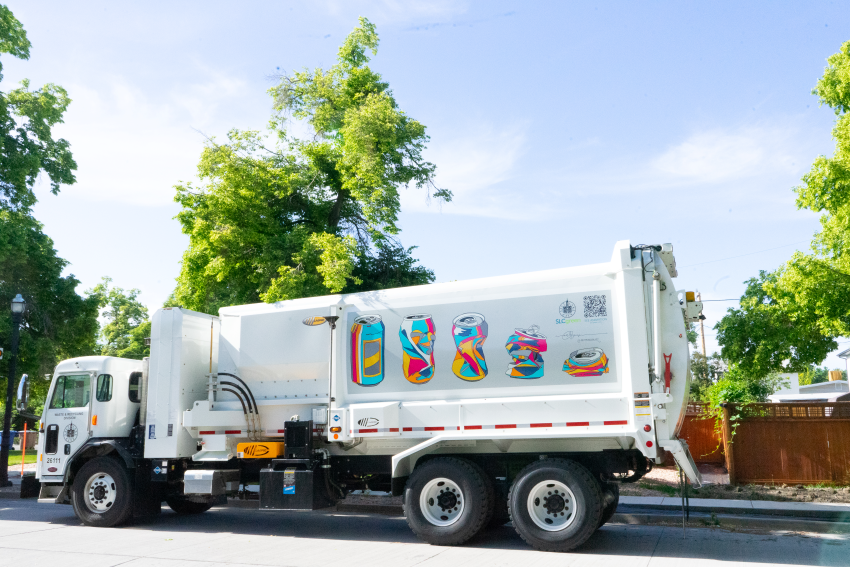
  • Partnered with three local artists to create new wraps on our newest refuse trucks.

AIR QUALITY

2022 Accomplishments

  • Hosted an Indoor Air Quality Summit and launched a new public campaign to share best practices around keeping our homes, buildings, schools, and other spaces healthy.
  • Submitted a grant application for an EV car share pilot program at affordable housing properties
  • Expanded the City’s Comprehensive Sustainability Policy so that all new construction and major renovations of large City buildings will, when practicable, be constructed to use all-electric, combustion-free technologies.
Continue reading

Making Headway: An Update on the Community Renewable Energy Program 

As you may know, Salt Lake City is helping lead a coalition of communities working with Rocky Mountain Power to achieve our net-100% clean electricity goals by 2030.   

As 2022 comes to a close, we want to give you an update on the exciting and important work that’s been happening with our goals and the program this year.  

We’ve been steadily developing the governance structure and outlines of the program since it became established in state statute after the passage of HB 411 in 2019.  You can learn more about the beginnings of this program and our carbon goals here. 

This year we celebrated a total of 18 communities moving forward as of the July 2022 participation deadline. (There will still be another vote—likely in late 2023—by each participating community’s council to decide whether to participate in the final program once it’s approved by the Public Service Commission.)  

The 18 communities form what’s called the Community Renewable Energy Agency, the interlocal government cooperative working to design this Program. 

And, together, we can have a big impact on renewable energy development in the state and region!  Collectively our communities represent about 25% of the electricity that Rocky Mountain Power sells in Utah.   

The Program will bring new renewable energy resources to serve Salt Lake City and participating communities, so that by 2030, the amount of electricity we use annually will be matched by renewable generation.   

This means the Community Renewable Energy Program has the potential to source 25% of the electricity the utility sells in Utah from renewable energy!  

This is important because climate scientists agree that in order to avert the worst impacts of climate change on our health, ecosystems, economies, and societies, global emissions must be halved by 2030 and reach net zero by 2050.   

Developing and implementing the Community Renewable Energy Program is one of leading strategies that Salt Lake City and other participating communities are taking to #ActOnClimate in line with these science-backed targets. 

Community Renewable Energy Agency Updates 

Continue reading

We’re Dreaming of a “Green” Christmas

The holiday season can be a time of joy, time spent with friends and family, gift giving, good food, and rewatching our favorite comfort movies.  It’s also a time when thinking about and acting on sustainable alternatives is important! 

Holidays bring about plastic and paper waste, increased travel emissions, food waste, and the never-ending debate over plastic versus real trees. Check out some our tips for navigating this holiday season as sustainably as possible! 

Shop local: 

We’ve talked about the importance of shopping local for our food, but shopping local for gifts is also important! Keeping our shopping to our local, small businesses helps support the local economy. Additionally, shopping locally minimizes carbon emissions because travel is minimized for consumers and purveyors.  Supporting small, local businesses also helps to sustain our town centers and can help reduce sprawl and automobile use

Food waste: 

Food waste is a major issues even outside of the holiday season- about 40% of all food produced in the US never gets eaten.  This amount increases by an additional 25% between Thanksgiving and New Years! Here are a couple of easy ways to minimize your food waste: 

  • Plan a head! Figure out your menu ahead of time and plan for the amount of people who will be attending your event. Try and plan foods that you will enjoy eating as leftovers or can repurpose into other dishes (like turkey soup, curry, or sandwiches!). Consider doing more plant-based options for an increased impact! 
  • Compost! Any of the raw fruit and vegetable scraps created in the cooking of your delicious feast  can go into your compost bin to be turned into compost for you to use during the next planting season! Learn more about composting in SLC here
  • Send people home with leftovers! Tell your guests to bring their own to-go containers to help you eat through any remaining leftovers. 
Continue reading

A Vegetarian Thanksgiving

Thanksgiving can be a difficult holiday for those practicing vegetarianism or veganism- with food being such a focal point and the main dish often being meat based. While there are other ways to contribute towards a sustainable lifestyle, how we eat is a major player in our individual carbon footprints. In Utah, these choices contribute to nearly 25% of our  household carbon footprint. Learn more about Dining with Discretion and the importance of understanding the intricacy of our food systems!

A vegetarian Thanksgiving can be easy, there are vegetarian/vegan roasts you can get at the store, but there’s something about creating a flavorful dish to share with your guests that took preparation and dedication. We wanted to make this holiday a little easier for our vegetarian and vegan friends this year so we made a menu, just for you!

Appetizers:

Stuffed Mushrooms

Kale and White Bean Artichoke Dip*

Candied Spiced Nuts

Pastry Wrapped Cranberry Brie

Continue reading

Salt Lake City BIPOC-owned Westside businesses to receive funding to go solar

PRESS RELEASE: November 17, 2022

A year-long effort to create solutions for Black-, Indigenous-, and People of Color- (BIPOC) owned businesses on the Westside of Salt Lake City to pursue rooftop solar and battery storage has received a significant boost thanks to a commitment from American Express.

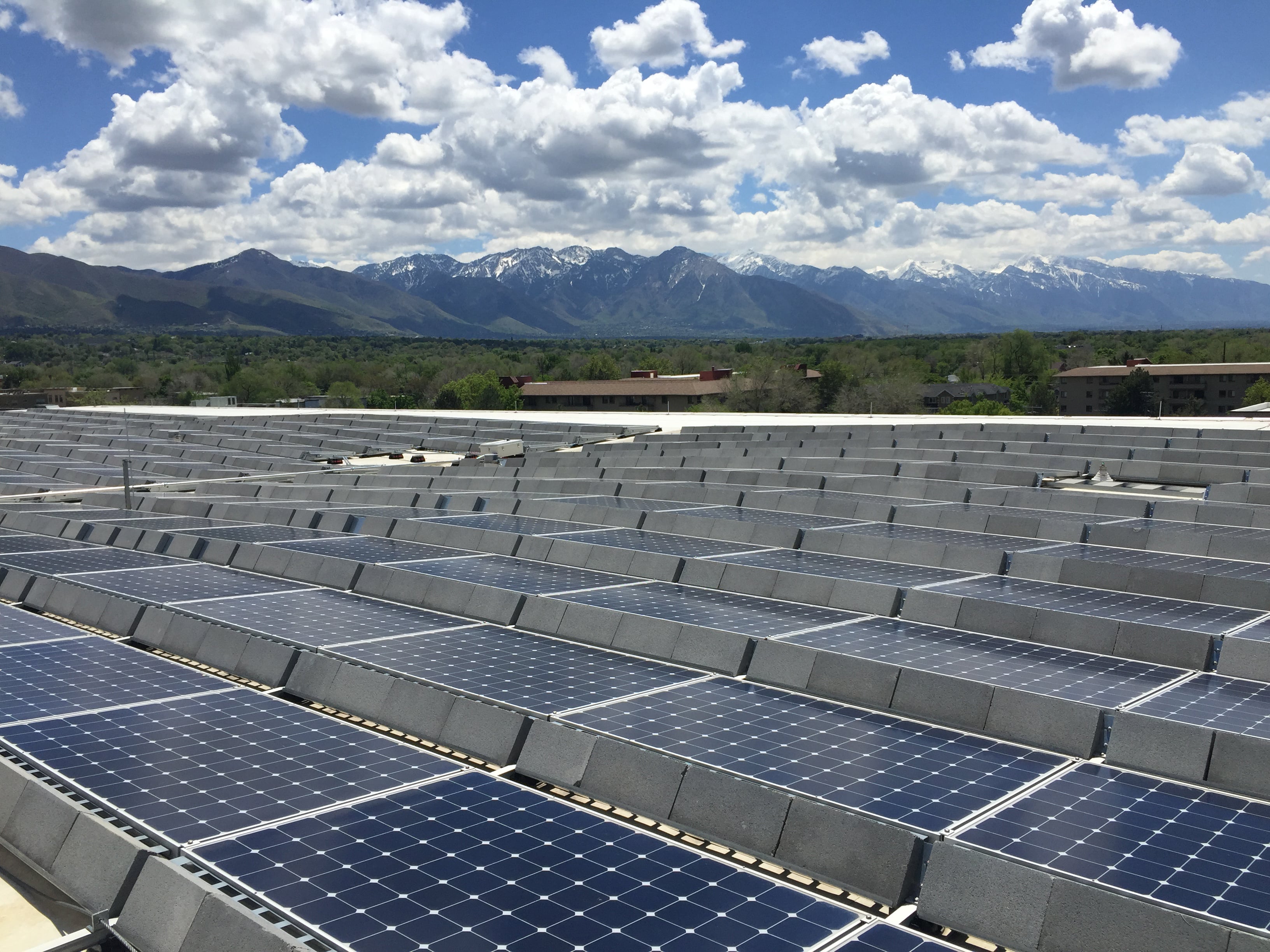
American Express recently announced a $5 million global commitment to help cities build resiliency and fight climate change ahead of the United Nations Climate Change Conference which took place in Egypt last week. The Urban Sustainability Directors Network (USDN) has been awarded $1.2 million to work with three cities, including Salt Lake City, to install solar energy systems in our community.

American Express will provide $325,000 in philanthropic support to complement other incentives and financial strategies to help install solar with optional battery systems for small businesses on the Westside. These systems can lower energy costs for residents and businesses, can be more resilient than standard electric sources during extreme weather, support local clean energy jobs, and reduce greenhouse gas emissions.

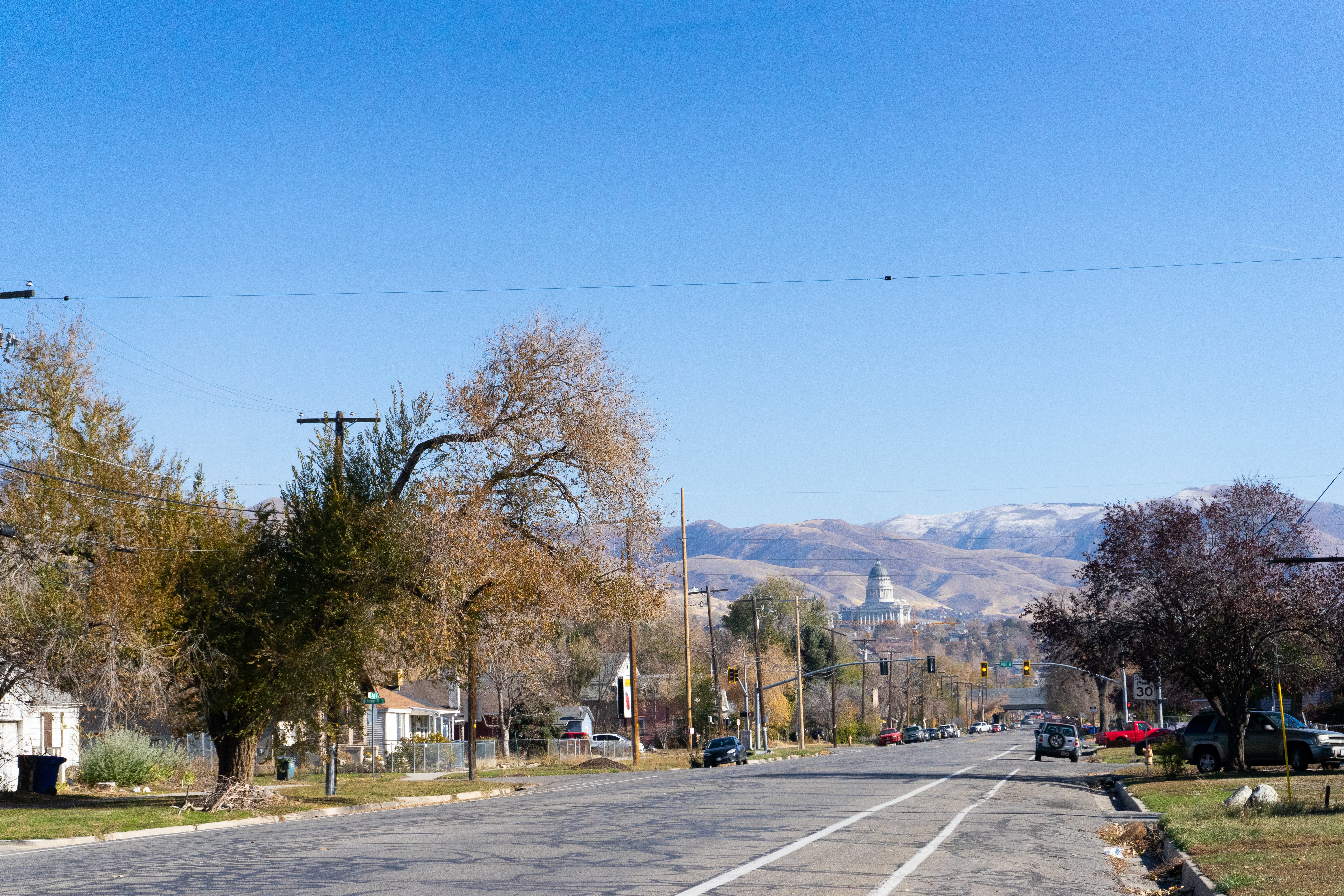
View of the Utah State Capital Building from 500 North.

“I’m thrilled with American Express’ generosity, which will build off the hard work our City team and partners have done to advance solar on our Westside,” said Salt Lake City Mayor Erin Mendenhall. “We have the tools to reduce climate emissions, strengthen community resiliency, and save our businesses and residents money through clean energy, and this collaboration is a perfect demonstration of that.”

Continue reading

Inversion season is here! What can we do?

November 1 is the official start of inversion season along the Wasatch Front and it certainly feels like  winter is settling in around us!

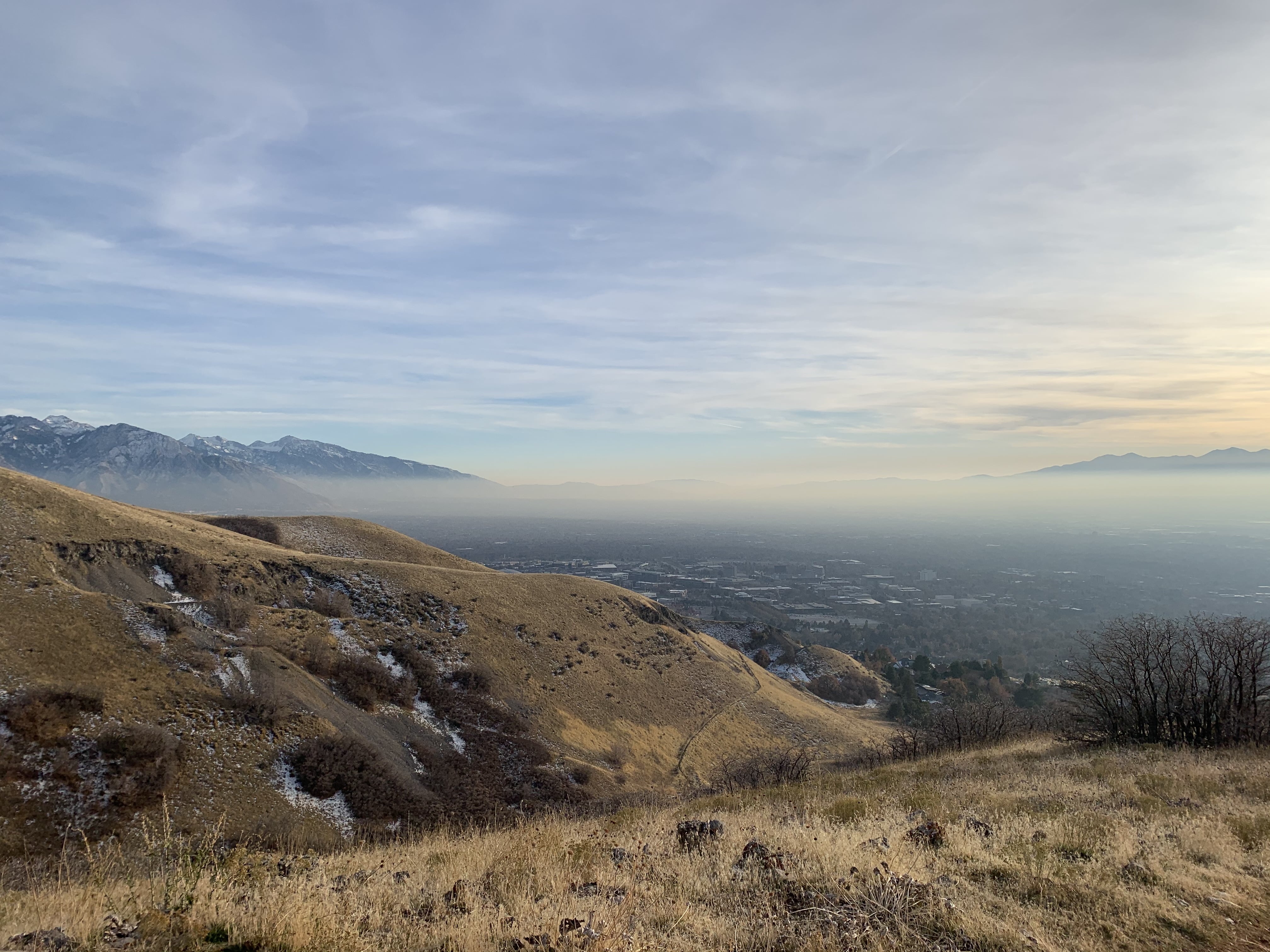
But what exactly is an inversion? This natural phenomenon occurs when a high-pressure system is setting up, trapping cold air on the valley floors with warmer air above it. This warm air also traps all our pollution with the cold air, keeping it contained in the valley until the inversion breaks. 

What causes an inversion? 

Meteorologists on the news and the Utah Division of Air Quality will  warn you in advance before an inversion happens. Here are some signs that you can keep a look out for: 

  • Calm winds: this reduces the natural mixing of air temperatures. 
  • Clear skies: this increases the rate of cooling for air close to the ground. 
  • Long nights allow the cooling of the ground to continue over a longer period of time, resulting in a greater decrease in temperature near the surface. 
  • The sun is lower on the horizon during the winter, so it supplies less warmth to the earth’s surface and more to the atmosphere. 

In Utah, our inversions often occur right after snowstorms due to the increase in cold air near the ground and the clear skies warming up the upper atmosphere and acting as a lid to the cooler air below. 

Inversions are meteorological events that are common in mountain/valley geographies with our weather patterns.  When you pair inversions with human activity, you often wind up with pollution that sticks around.  Here along the Wasatch Front, a significant source of pollution comes from transportation(roughly 50%), as well as our homes and buildings (roughly 35%). That means each of us can make a difference to our air quality. 

What can you do? 

Continue reading