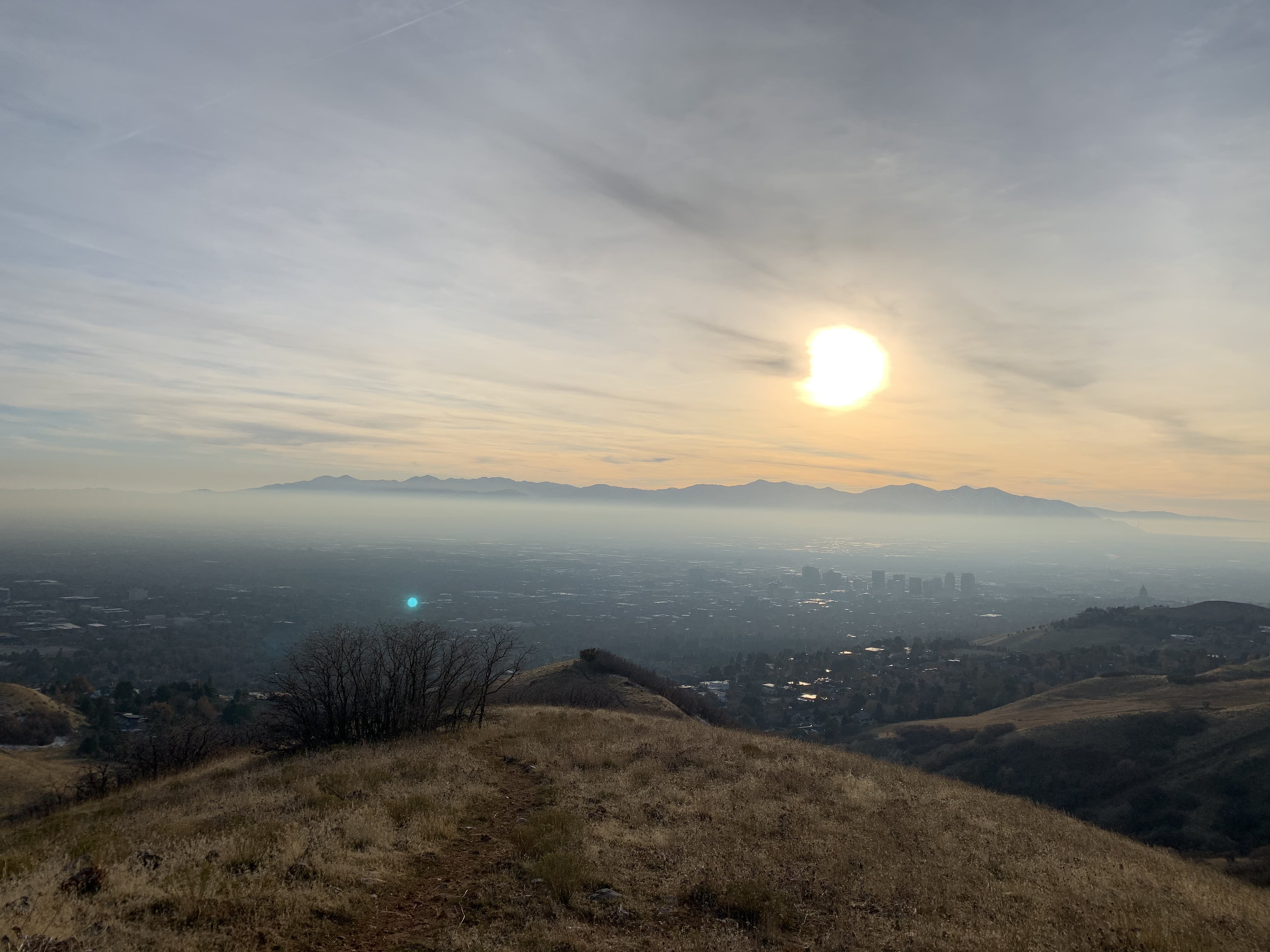
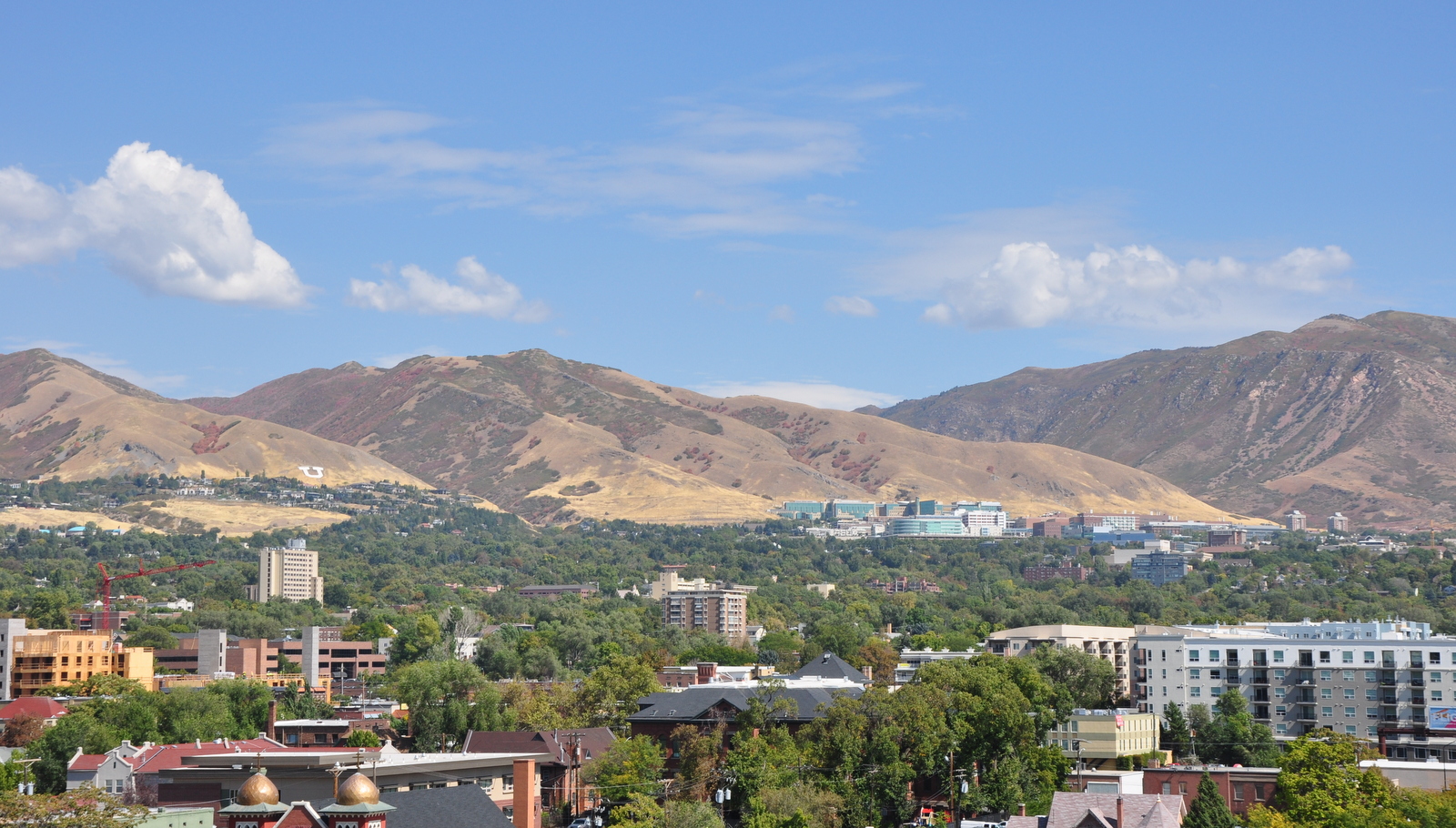
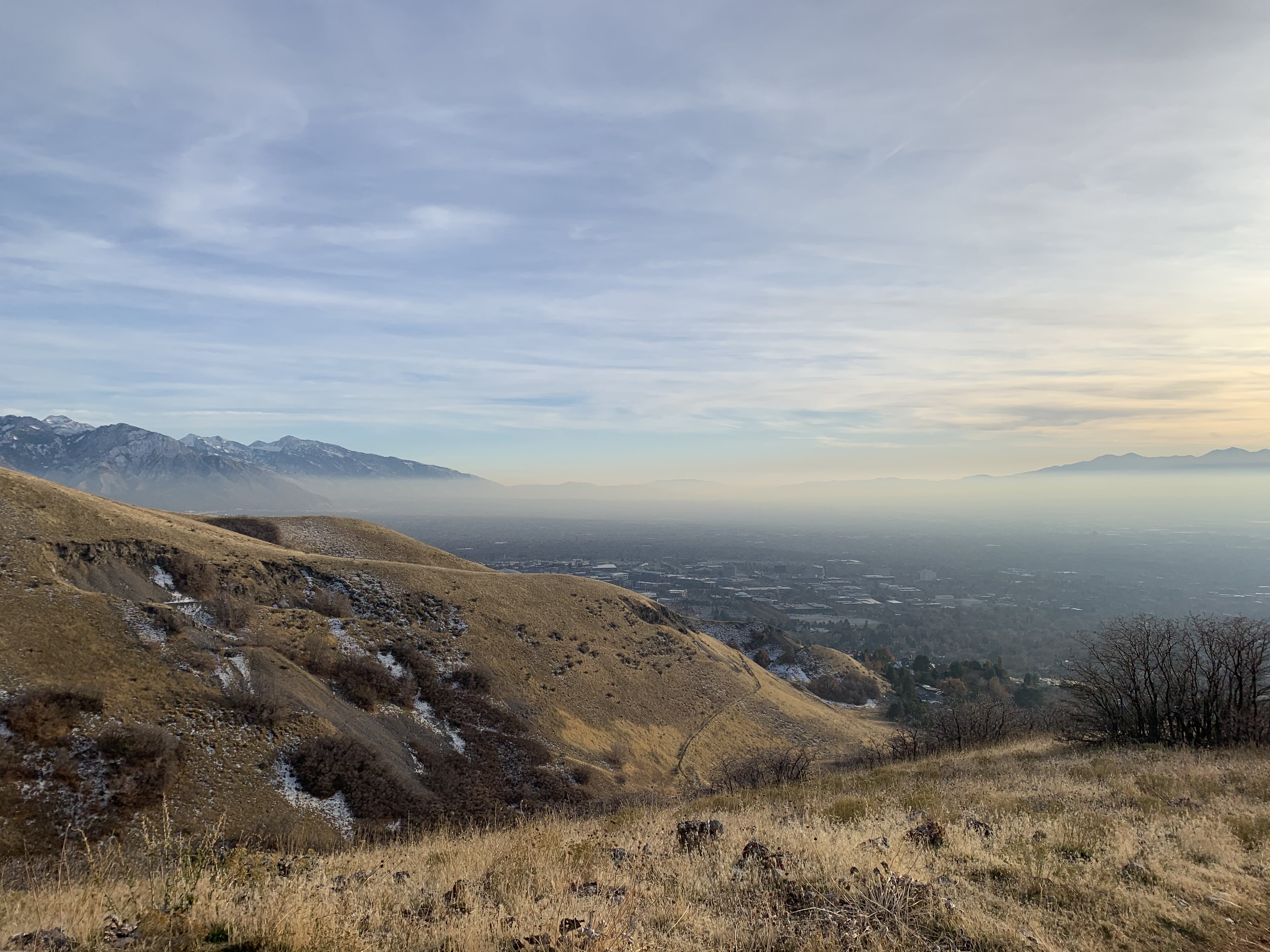
November marks the beginning of inversion season in the Salt Lake Valley. This is the time of year when pollutants including PM 2.5 get trapped in the valley, obscuring the mountains and posing dangerous health risks to our communities.
Protecting our airshed and reducing pollution wouldn’t be possible without the collective actions of everyone coming in and out of Salt Lake City. While transportation contributes a significant portion of the local air pollution, other factors including building efficiency and home energy use can also contribute to pollution. Studies have shown that air pollution disproportionately affects communities of color, partially as a result of source location and historical redlining of neighborhoods. Air quality continues to be a major equity concern for Salt Lake City, where proximity to major highways, industrial areas, and fewer trees make some parts of Salt Lake City more polluted than others. By addressing air pollution’s many sources, Salt Lake City can help improve air quality.
Keep reading to find out more about what you can do to help everyone breathe a little easier!
As we celebrate the 5th Annual Utah Climate Week, it is a great time to take stock of the ways we can act on climate at home. In our last post, we talked about the importance of energy efficiency. The cheapest and most “renewable” energy is the energy we don’t waste.
After you’ve made energy efficiency improvements to your home, it’s time to look at the type of fuel you’re using to power it!
Perhaps you have solar on your roof or a subscription to Blue Sky. Or maybe you’re supporting Salt Lake City’s efforts to move all of our community to net-100% renewable electricity!
As our electricity sources get cleaner, moving towards partially or fully electrifying your home is one of the many ways you can use to reduce your carbon footprint, as well as reduce local air pollution. When we advocate for building electrification, we mean switching to using all-electric appliances and heating/cooling systems in your home.
Building electrification can be accomplished at any stage — whether you are updating an old or broken appliance, renovating your space, building a new home, or just looking for ways to live more sustainably.
Benefitting the Environment
It may come as a surprise, but choosing energy efficient electric appliances and scaling-back the use of natural gas, heating oil and other fossil fuels will significantly reduce your household’s greenhouse gas emissions.
You might be thinking: But if my electric grid is powered primarily by fossil fuels, how will switching out my gas appliances for electric lower my carbon footprint? The short answer is energy efficiency and a grid transitioning to renewable sources.
Salt Lake City Mayor Mendenhall’s new 2021-2022 city budget emphasizes financial stability for Salt Lake City, as well as “opportunities for an abundant, transformational, equitable future for all the city’s communities.”
The $350 million budget allocates funds to numerous initiatives and programs that will help Salt Lake City implement recommendations from the Commission on Racial Equity in Policing as well as expanding support for affordable housing. Salt Lake City will continue to prioritize building a sustainable and resilient city for all residents.
Due to the COVID-19 pandemic, residents have had unprecedented access to local government, connecting with departments more than ever. As SLCgreen moves into the new fiscal year, which begins July 1, we aim to build from this access, inviting more of our community into the decision making process, and working with the community towards greater sustainability and resiliency for all.
The newly approved budget allows Salt Lake City to continue to invest in critical public services, renewable energy projects, air quality, food access, climate equity, and more, which are described below.
Waste and Recycling Rate Increase
The adopted budget contains a rate increase on garbage containers. As you may recall, the Sustainability Department undertook a large public engagement process in late 2019/early 2020 to evaluate residents’ satisfaction with our waste & recycling services, and to seek feedback on how they’d like to see future rate increases occur.
While we do not take lightly the fact that rate increases impact everyone– and some more than others– we want you to know that we have worked hard for years cutting costs and streamlining our operations to forestall the need for a rate increase. However, it has been nearly seven years since we last raised rates. In that time, the cost of doing business has increased– impacting everything from purchasing and maintaining our refuse vehicles, to disposing of garbage at the landfill, to keeping up with the cost of living. For a couple of years, there were also fees associated with processing the City’s recyclables. (So far in 2021, we have begun to make money again on recycling which is great news. We are committed to maintaining a robust program through the ups and downs of the recycling commodity market).
You can visit this page to learn more about the rate increases, the survey, and what to expect. As always, if you have questions or comments, don’t hesitate to reach out to us at slcgreen@slcgov.com
Projects on Energy, Food, Air Quality & More
In our policy division, we are moving forward with some impactful and important projects. Here’s a closer look at some of what’s in store for the Sustainability Department’s Energy & Environment Division:
Advancing Salt Lake City’s Community Renewable Energy Goals
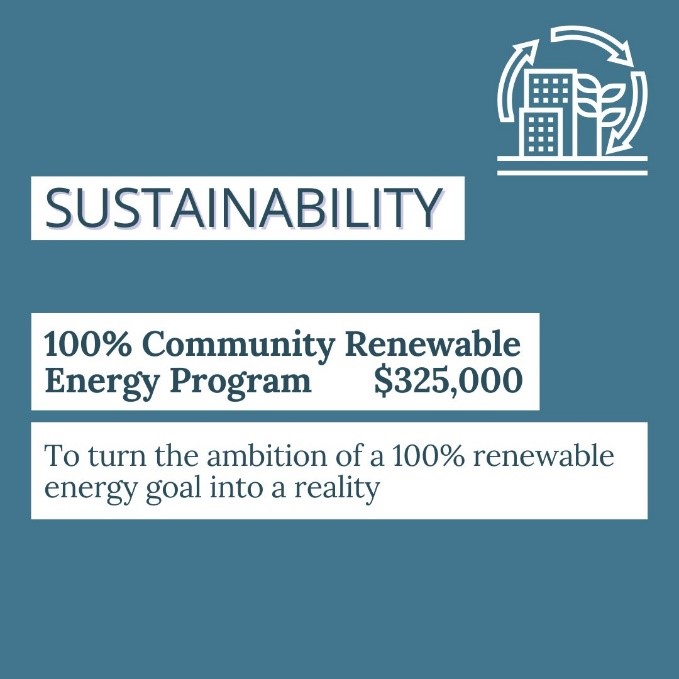
The Community Renewable Energy Program (C-REP), empowered by the Community Renewable Energy Act, H.B. 411, will help Salt Lake City reach its goal of community-wide net-100% renewable electricity. In 2022, Salt Lake City will work with other participating communities to bring Salt Lake City closer to its goal of 100% renewable electricity for the whole community. Learn more on the Utah100 Communities’ website.
A warming climate makes air pollution worse – from increased wildfires to the formation of ground-level ozone.
As temperatures go up, so does ground-level ozone. This is the ozone that forms when emissions from our cars, lawnmowers, other sources of combustion, and certain chemical products react with sunlight and heat.
Ozone is damaging to our lungs and cardiovascular systems. It’s an invisible, odorless chemical, but being exposed to it is described like “receiving a sunburn on your lungs.”
That’s why it’s important for everyone to work together to reduce pollution. Check out the Utah Department of Environmental Quality’s list of best practices for reducing ozone during these hot, sunny days.
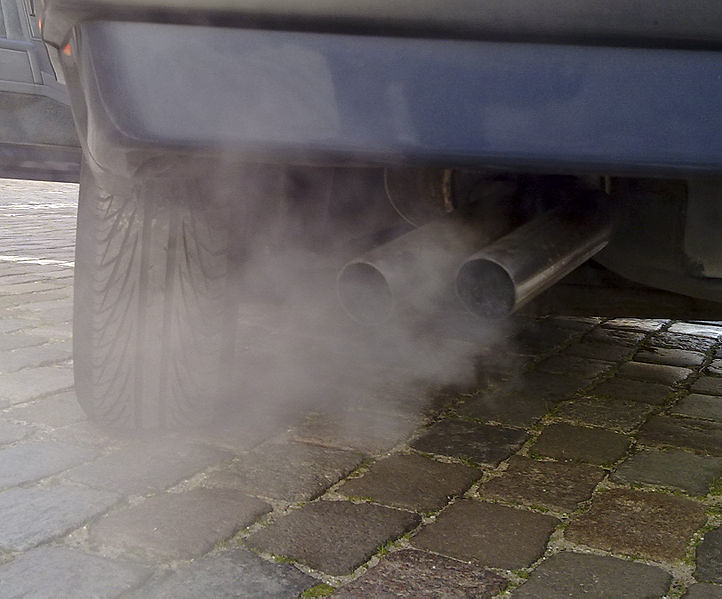
One of the biggest ways to reduce air and ozone pollution is to drive less. Vehicle exhaust contributes a sizeable chunk of our ozone pollution.
And if you do have to drive? Remember to turn your engine off and be idle free when stopped in your vehicle (when not in traffic).
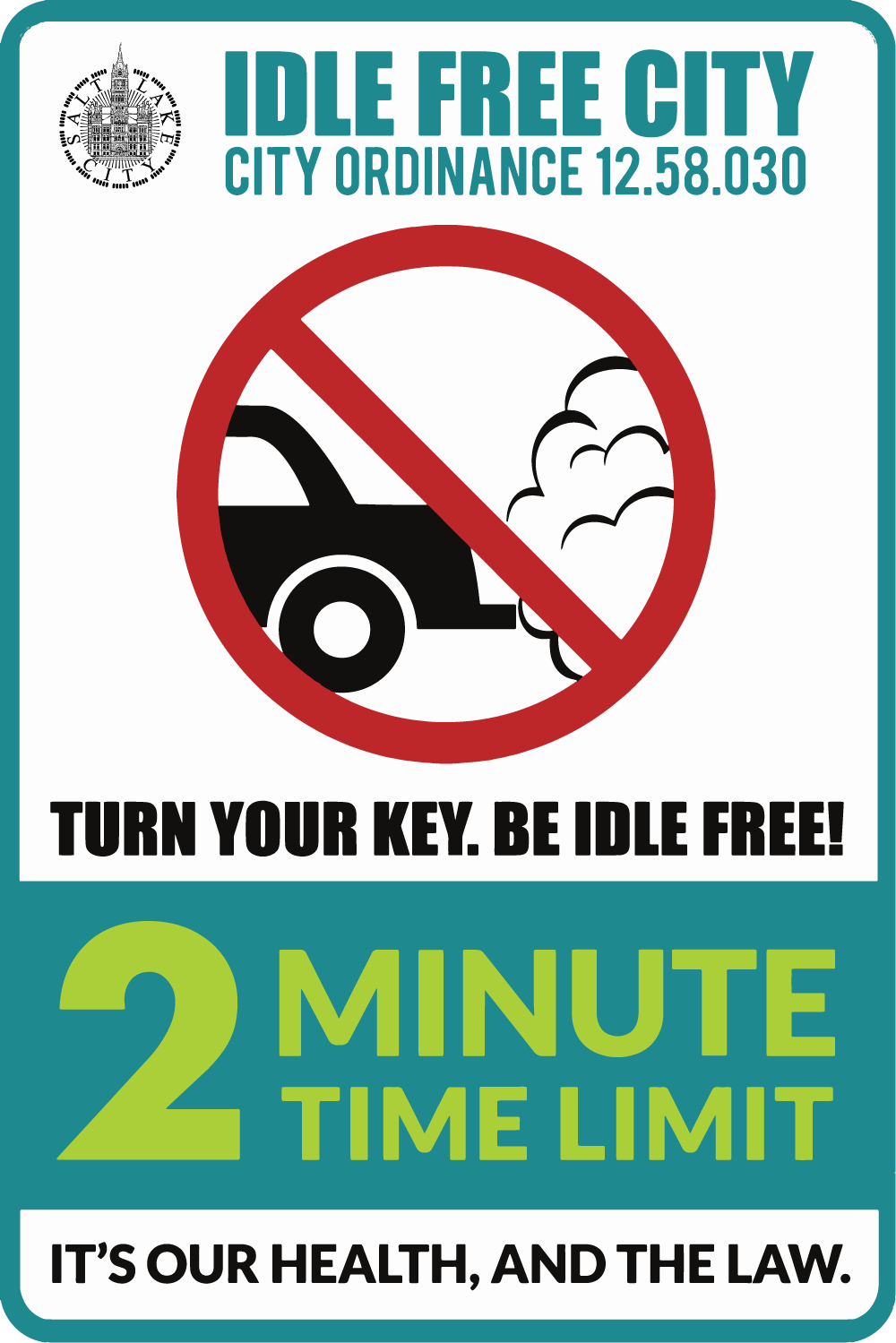
Excess vehicle exhaust threatens our air quality and the overall health of our communities. That’s why in 2011, Salt Lake City enacted one of the first Idle Free Ordinances in the state.
The Idle Free Ordinance prohibits unnecessary idling over two minutes within Salt Lake City limits. The ordinance prioritizes our community’s commitment to improving local air quality.
Idle Free Ordinance Update
Thanks to a 2019 state legislative change, Salt Lake City was able to update our 2011 Ordinance this year to better serve its purpose of limit idling in Salt Lake City. Specifically, the law (HB148) allows Salt Lake City to issue only one warning before issuing a ticket for idling. Previously, the city was required to issue three warnings.
The idling time limit will stay the same: unnecessary idling for more than two minutes is prohibited.
Some idling, of course, is necessary. For example, when stopped for an official traffic control device or signal, or if you the health and safety of a driver or passenger (including service animals) requires it. However, in ordinary driving situations, lengthy stops are generally limited, and when you do make a stop, remember to turn the key and be idle free!
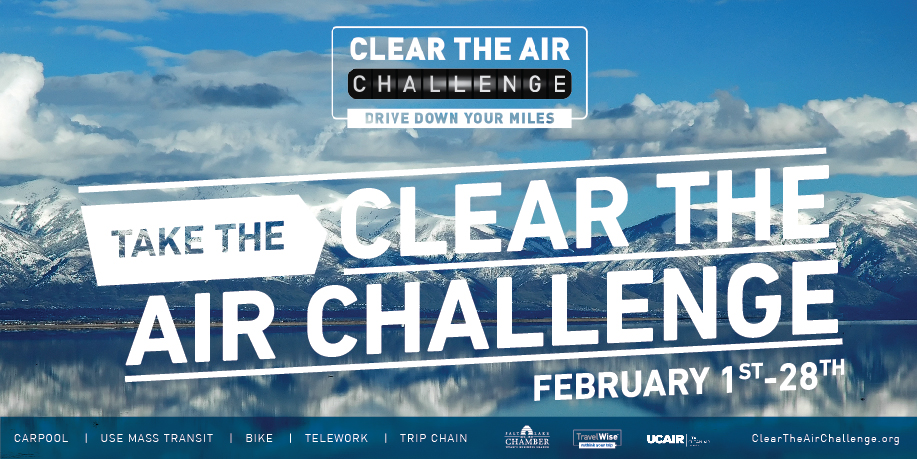
February is (finally!) here! And that means that the Clear the Air Challenge has begun!
In the last few years, Utahns have worked together to improve air quality in the Salt Lake Valley. Early last year, the EPA announced Salt Lake City and Provo were in compliance with federal standards for PM 2.5, the fine particulate matter that pollutes our air quality along the Wasatch Front. This significant milestone came after years of community wide work to take action to clear the air.
In 2020, we learned that the steps we took to slow coronavirus cases resulted in quick changes to our air quality. COVID-19 continues to threaten our community’s health and economic security, resulting in increased social inequities. Many of the changes we’ve made in this crisis are not sustainable in the long term. However, our work to improve Salt Lake City’s resiliency includes taking actions that support public health and security, and that address environmental issues like air quality.
This month, we challenge Salt Lake City community members to participate in the 12th annual Clear the Air Challenge! The Clear the Air Challenge is a chance to level up your efforts to improve air quality. The Challenge runs the entire month of February, chosen due to the seasonal inversion that makes wintertime air quality especially bad. However, the steps you take this month can make a difference for our air all year long.
For many of us who are still spending more time at home, the challenge will feel a little different this year. We’ve put together some helpful facts, tips, and inspiration to get you going on the 2021 Clear the Air Challenge!
2021 is here! SLCgreen is excited to move forward. But as we prepare for the year to come, we’re also ready to incorporate what we’ve learned from 2020.
At the beginning of 2020, SLCgreen was eagerly preparing for a new administration and planning for a year of innovative sustainability projects. After a busy 2019 we were ready to take the next steps towards bringing net-100% renewable energy to our community. A new state-of-the-art recycling facility was near completion. And an innovative resident-led food equity program was convening to help improve food access in Salt Lake City.
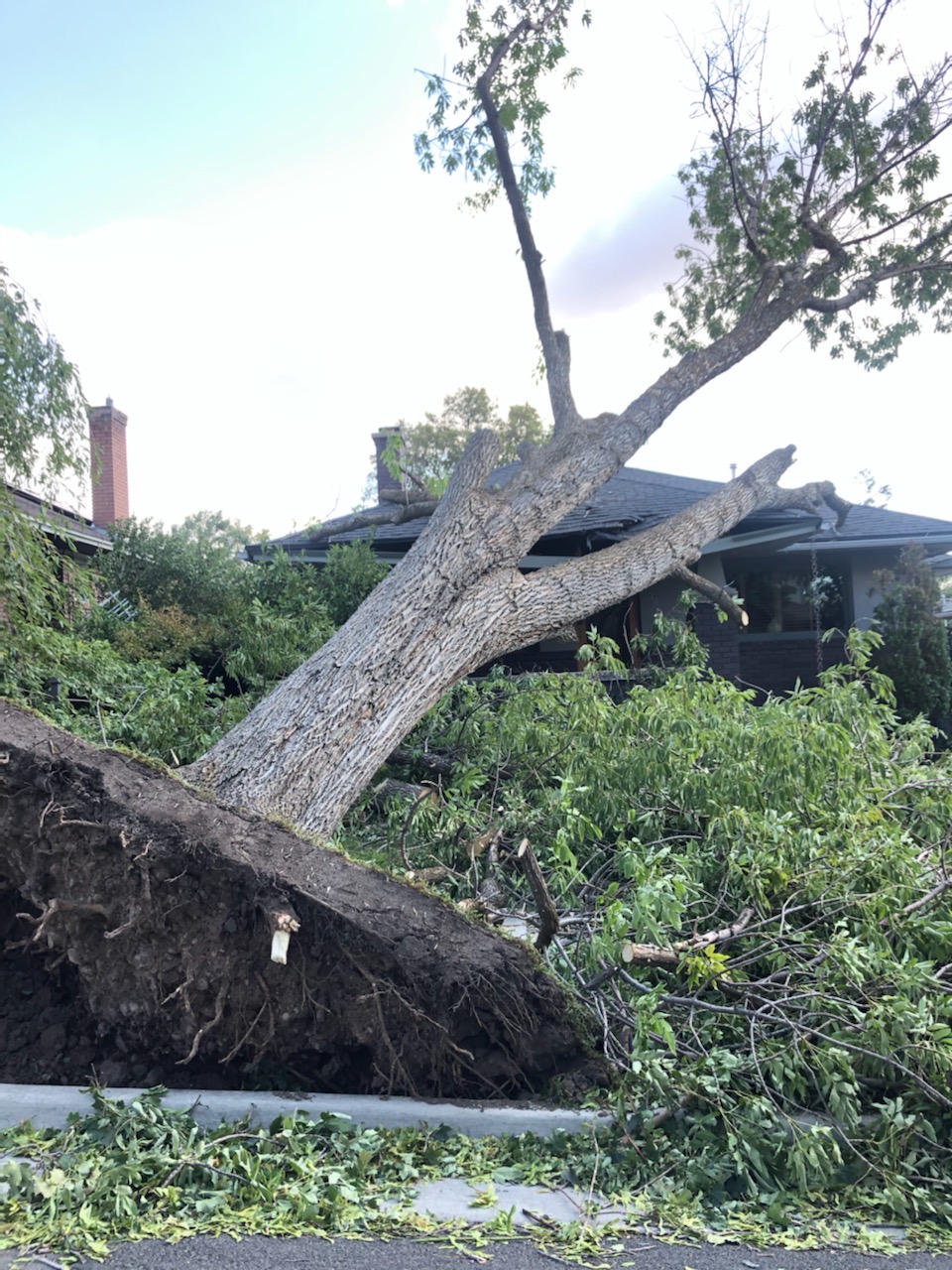
The challenges of the past year have been harrowing. Within the first months of 2020, Salt Lake City pivoted our work to respond to the COVID-19 pandemic. We experienced an earthquake that damaged our homes and businesses. Hurricane-force winds toppled thousands of trees and left many members of our communities without power for several days.
Despite it all, SLCgreen was able to accomplish many of our goals with the help of our dedicated crews and community members. The challenges our community faced in 2020 laid bare the deep connections between equity, resiliency, and climate action. The year required us take more direct actions to improve our emergency response plans, to better support the voices of residents who have been excluded in the past, and to expand our communications to facilitate more collaborative work.
SLCgreen is ready to build off of what we learned during the past year, but before we set our sights on 2021, here are a few highlights from 2020.
Home damage from the hurricane-force wind storm Salt Lake City experienced on Sept. 8, 2020.
.
So far 2020 has been a record year for climate-related natural disasters. Alongside the global coronavirus pandemic, severe weather like what we experienced with last week’s wind storm, record breaking temperatures in August, and fires burning throughout the Western United States, have shown us first-hand the effects of climate change in our backyards.
That’s why it’s more important than ever to call attention to climate change– and the urgency of taking action at all levels.
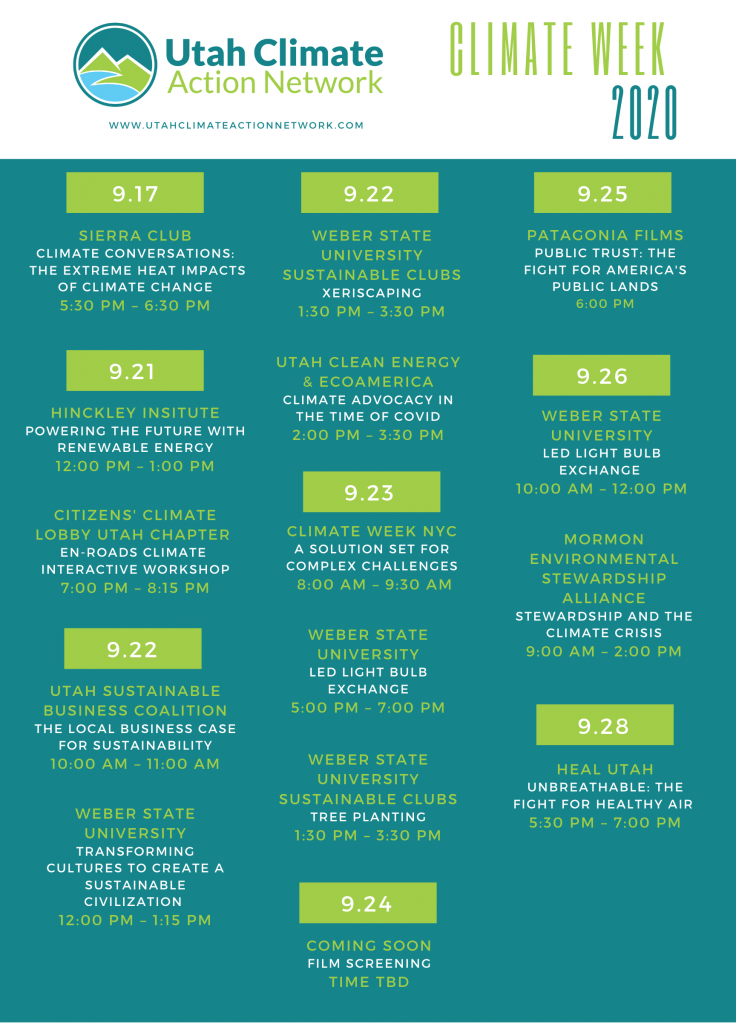
We’re in luck because the Fourth Annual Utah Climate Week is coming up from September 21 – September 27 and offers everyone the platform not only to learn and engage, but also to call attention to climate change during what has seemed like a year of jumping from one immediate crisis to another.
So many people are struggling and so many are exhausted with all 2020 is bringing to bear on our communities. We hear that and we feel it too.
And that’s exactly why we must continue looking at the big picture, and to draw the connections between immediate events and the larger harm we’re doing to our planet.
This year’s Climate Week will be a little different– there won’t be in-person events, but there are a suite of interesting and engaging events taking place online and we hope to see you at one or more of them.
Then join us on social media to highlight why you care about climate change. Use the tags #UtahClimateWeek and #ActOnClimate to call attention to this issue!
If you’re not a big social media user, take the opportunity to do some learning, then perhaps have a conversation with your friends, family, or other networks. Whatever you do: Learn. Activate. Engage. Let’s go!
Utah Climate Week is an annual event– now in it’s fourth year– and is coordinated by the Utah Climate Action Network, Utah Clean Energy, and many partners. The week provides a chance to learn, share resources, and re-commit to the necessary work to #ActOnClimate.
We’ve been involved in planning and coordinating one event in particular and we’d like to invite you to attend.
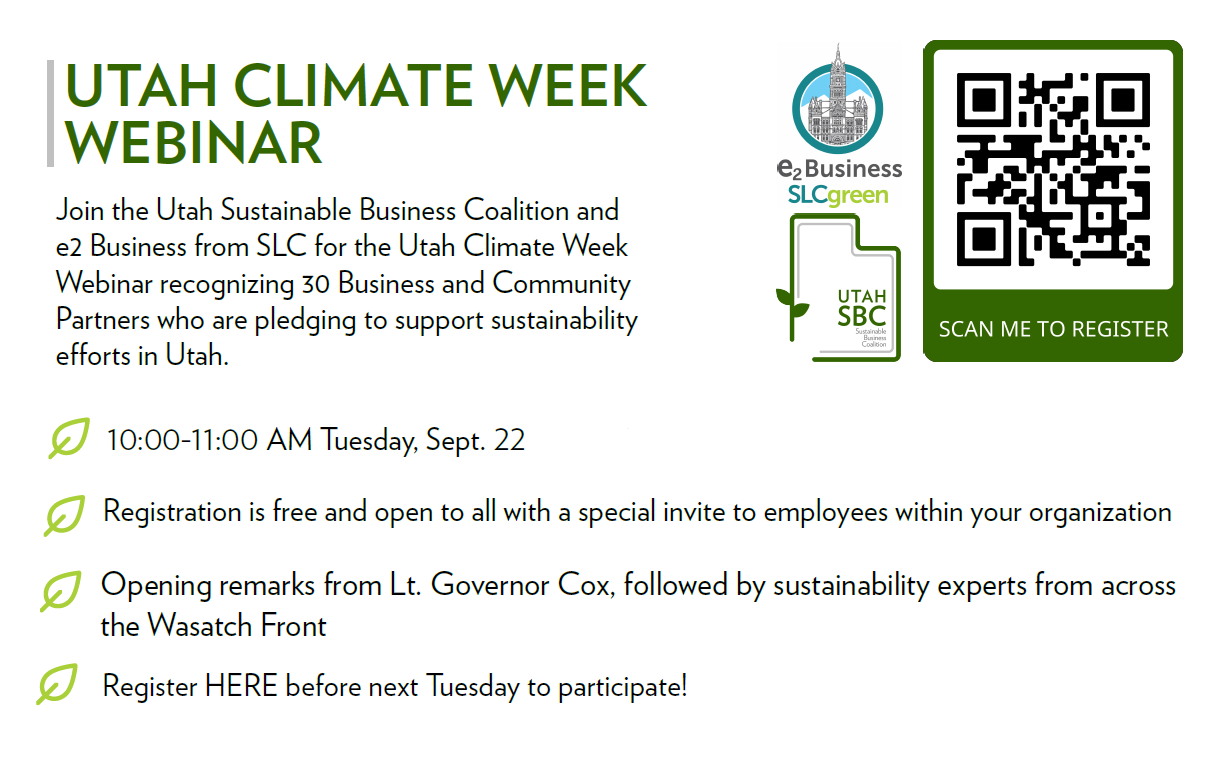
The Utah Sustainable Business Coalition and the Salt Lake City e2 Business Program are hosting a panel discussion on how local businesses of all sizes are working to improve sustainability at their companies.
The event will be held on Tuesday, September 22 from 10:00-11:00 a.m. on Zoom.Click here to register!
As we have noted in previous blogposts, sustainability and resiliency intersect with environmental, social, economic, and equity work.
Communities of color are disproportionately affected by climate change. In Utah, the health threats of air pollution are the most obvious example. On a global scale, climate change and pollution are affecting us all, especially coupled with COVID-19, starting with communities who are already experiencing systemic racism and inequity.
Because these areas of life are directly connected, it is important to take action on every level. Individuals; businesses; and local, state, and national governments have an important role to play in addressing inequity and supporting sustainability.
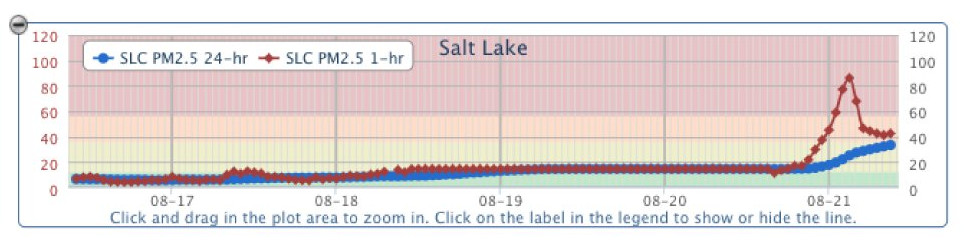
Earlier this spring we experienced a period of clean air due to lock-downs put in place to prevent the spread of COVID-19. However, Salt Lake City’s summer air quality has been recently impacted by smoke from nearby and regional wildfires, as well as from higher ozone pollution that is typical in the summer.
The Utah Division of Air Quality’s monitors showed a pronounced spike in pollution on August 21 as the winds brought wildfire smoke from California’s devastating fires.
.
Bad air quality threatens everyone’s health, particularly those with sensitive respiratory systems. The effects of bad air even have the potential to make COVID-19 even worse.Your lungs are already irritated and inflamed due to pollution, and this makes them more susceptible to infections like COVID.
Ironically, the pandemic – coupled with rising temperatures caused by climate change – are also behind the record number of human-caused fires in Utah. The feedback loop linking pandemic, fires, and bad air is disturbing, but there are ways we can take actions to help protect the air.
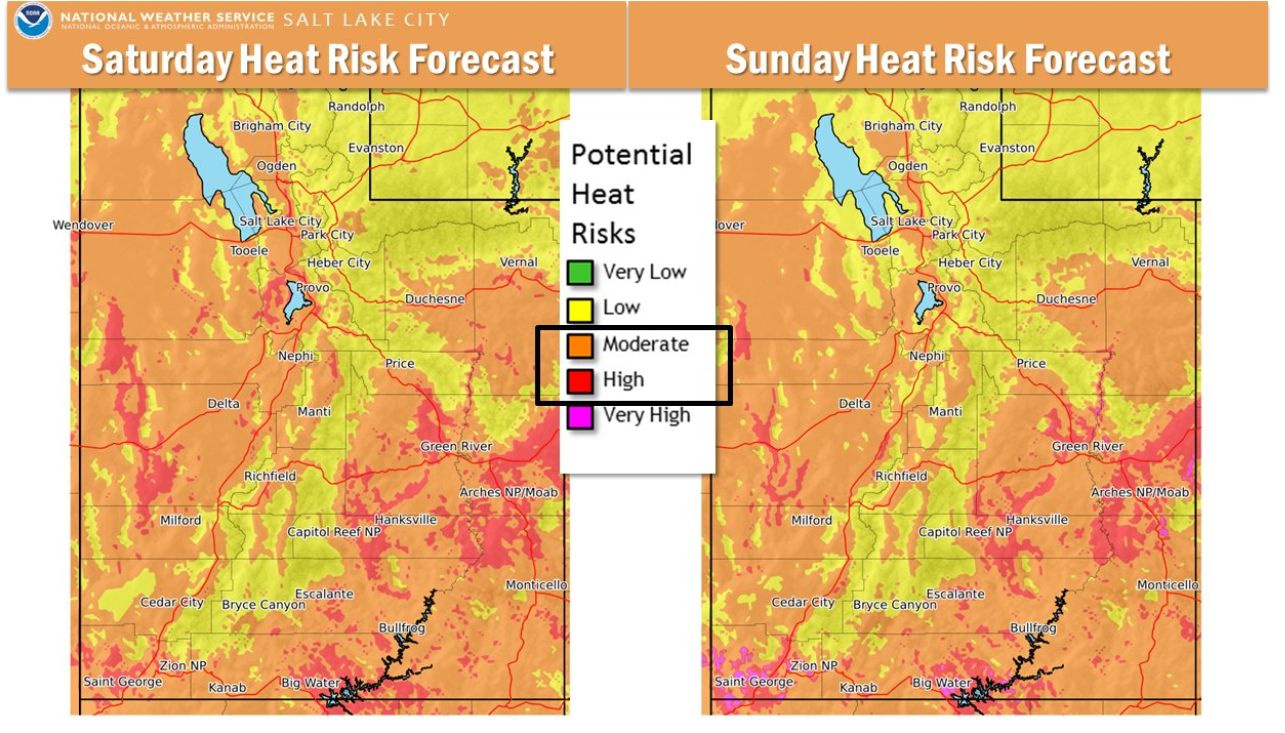
Summer in Salt Lake City can be beautiful, but rising temperatures make staying cool a challenge.
Staying cool during Utah summers is always difficult when the thermometer climbs above 90, 95, and 100 degrees Fahrenheit.
This year it’s even more challenging with the necessity of staying home, and the closures or limitation on public swimming pools, splash pads, and some cooling centers.
With more people spending more time at home, utility bills and household waste have spiked.
Stay Hydrated! Staying hydrated will help you stay cool and healthy, even when it’s hot! Read more about the signs of dehydration here.
Use your windows! Windows can be your best friend. Try to open things up at night to help cool your space down, but close the blinds or use window coverings when it starts to get hot our during the day.
Fans: Be strategic about box fans or overhead fans – they can help keep things cool and reduce the need for AC. But save energy by turning them off before you leave the house!
Optimize Space: Keep doors shut to areas you’re not using – that way you’ll be cooling a smaller space, which is more energy efficient!
Cook Carefully: Opting for recipes that don’t use the oven or require a long time on the stove will help keep your kitchen cooler – and may even help with your indoor air quality.
Switch to LED lights: Using more efficient lighting will help you save energy and money. LEDs, and other home energy efficiency improvements, can help you cut your energy bills and keep space cooler. Typical incandescent lights also put off more heat, so switching to LED reduces the heat burden in your home.
Salt Lake County Opens Two Cooling Centers this Weekend
In the months following our collective action to flatten the curve of COVID-19 cases, the air quality improved around the globe. According to University of Utah research, particulate matter pollution in Salt Lake City was reduced 59% as of May 6.
Although Salt Lake City is maintaining an “orange” status for our COVID-19 response, there has been an uptick in cases across Utah. In a city in which public health is harmed by poor air quality, any virus that affects the respiratory system is cause for concern. However, with the knowledge that stay at home orders temporarily reduced our local air pollution, we can learn more about possible ways of improving air quality in the future.
Let’s take a closer look at the ways air quality and COVID-19 interact – and some ways you can help protect the air and each other.